
Glossary·Written by a CPA
Stock-based compensation
Also called: SBC
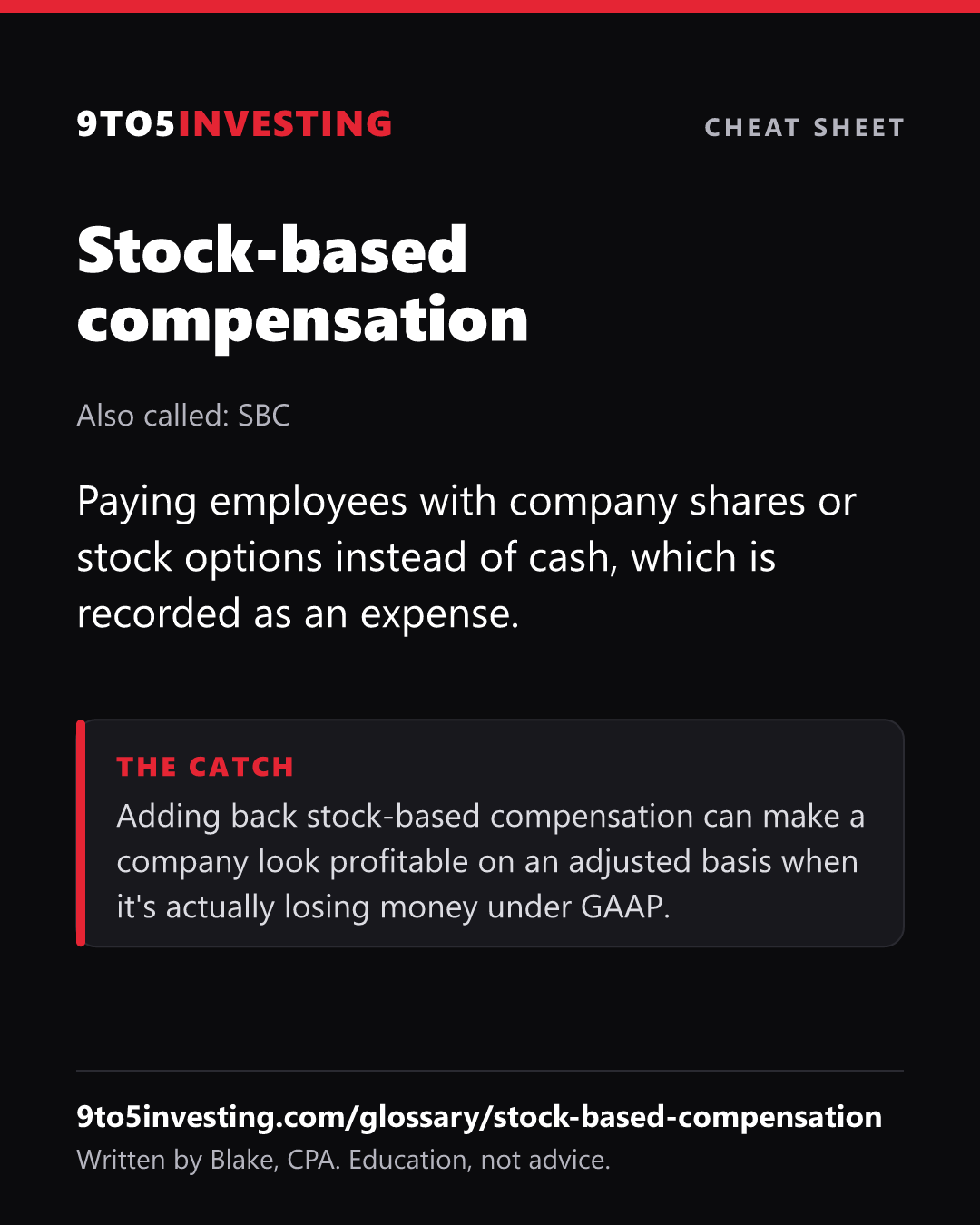
Paying employees with company shares or stock options instead of cash, which is recorded as an expense.
Stock-based compensation is when a company pays its people partly in stock, usually restricted stock units or options. All that I mean is instead of handing out more cash, it hands out a slice of the company.
Under GAAP, it's recorded as an expense, but because no cash goes out the door, it gets added back in the cash flow statement, and a lot of companies leave it out of their adjusted earnings too.
For you, it's a real cost even though it isn't cash. Shareholders pay for it through dilution, or the company spends cash on buybacks just to keep the share count from rising. It's worth comparing stock-based compensation to revenue to see how big it really is.
Example. As an example, say a company reports $300 million of free cash flow and $120 million of stock-based compensation. If you treat that compensation as a cost, free cash flow is $300 million minus $120 million, which is $180 million, so about 40% of the reported number came from paying people in stock.
The catch. Adding back stock-based compensation can make a company look profitable on an adjusted basis when it's actually losing money under GAAP.
Where I talk about it
- Don't Buy the Next Big IPO Until You Check These 7 Things at 4:17
- Why This $2 AI Stock Has a $9 Price Target (RZLV) at 4:42
- Anthropic IPO- Opportunity of the Year or AI Bubble? at 4:27
Cheat sheet
Free to save and share. Tap the image to open it full size.
Related terms
This is education, not tax or investment advice. I'm a CPA, but I'm not your CPA. Full disclaimer.