
Glossary·Written by a CPA
Adjusted earnings
Also called: Non-GAAP earnings
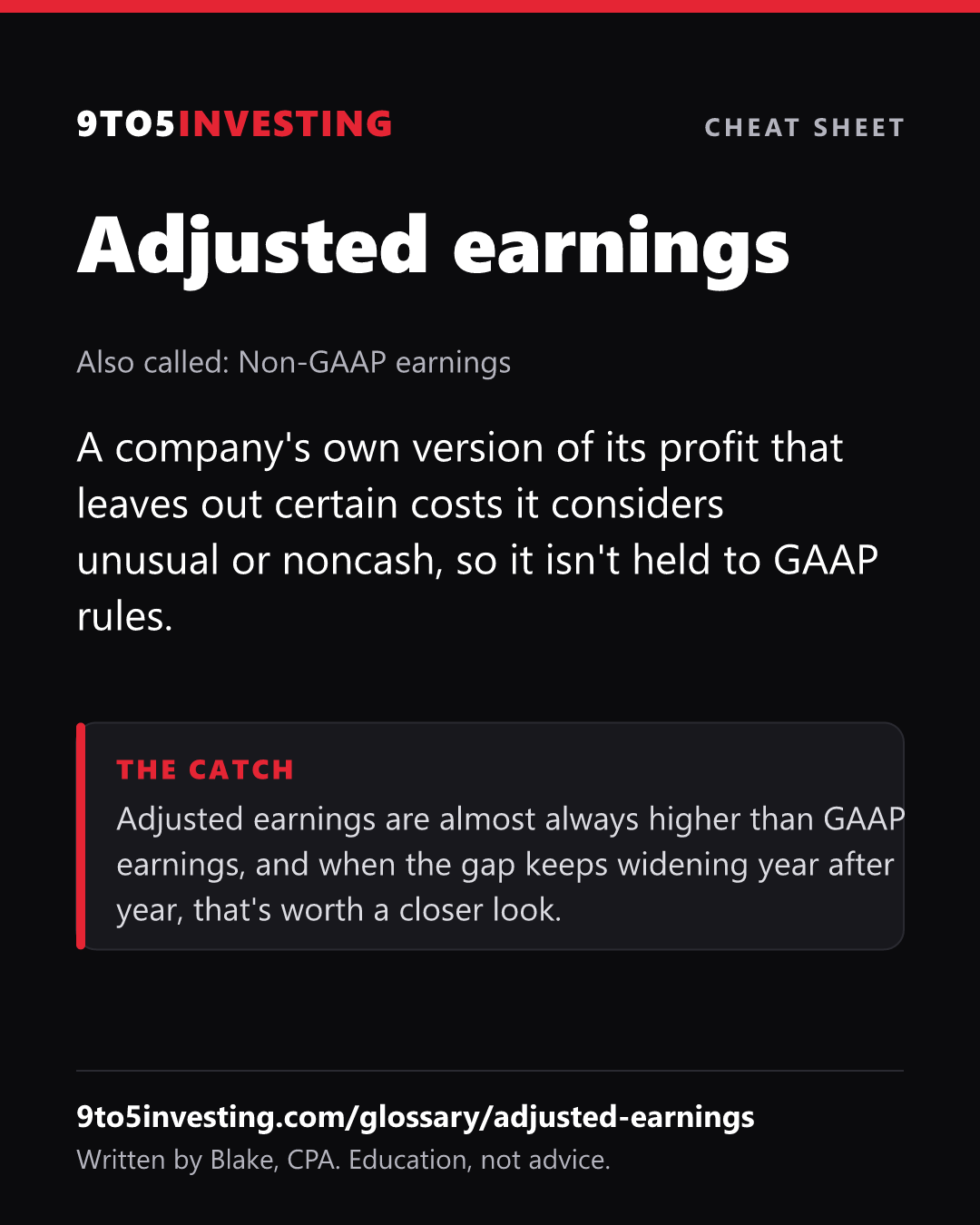
A company's own version of its profit that leaves out certain costs it considers unusual or noncash, so it isn't held to GAAP rules.
Adjusted earnings, or non-GAAP earnings, are the profit number a company builds on its own by starting with official GAAP results and then taking out costs it says don't reflect the core business. All that I mean is that the company is choosing what counts.
Common things that get removed are stock-based compensation, restructuring charges, the amortization of intangible assets from acquisitions, and one-time legal costs. Some of those adjustments are reasonable, and the SEC does require companies to show a reconciliation back to the closest GAAP number.
For you, the move is to read that reconciliation table. If the same so-called one-time costs show up every single quarter, they aren't really one-time... they're just part of running the business.
Example. As an example, say a company reports GAAP net income of $50 million. It adds back $40 million of stock-based compensation and $10 million of restructuring costs, so its adjusted net income is $50 million plus $40 million plus $10 million, which is $100 million. Same business, but the adjusted number is twice the GAAP one.
The catch. Adjusted earnings are almost always higher than GAAP earnings, and when the gap keeps widening year after year, that's worth a closer look.
Where I talk about it
- AMD Stock at $520? The $17 Billion Guide Explained at 4:14
- Sandisk Stock Split: The Price-Target Trap to Avoid at 7:02
- Fortinet Stock Crashed After Beating Earnings. Overreaction? (FTNT) at 0:41
- APP Stock: Sales Up 55%, Stock Down 60%. What Broke? at 6:55
- AAOI Stock at $69: The $160 Target Before Earnings at 5:24
- Intel Stock Fell 20% After Earnings Despite 78% AI Growth (INTC) at 0:29
- ServiceNow Stock Fell 15% After Beating Earnings. Here's Why (NOW) at 4:23
- This $2 AI Stock Just Announced $225 Million in Contracts. Read the Footnote. (BBAI Stock) at 4:36
Cheat sheet
Free to save and share. Tap the image to open it full size.
Related terms
This is education, not tax or investment advice. I'm a CPA, but I'm not your CPA. Full disclaimer.