
Glossary·Written by a CPA
EBITDA
Also called: Earnings before interest, taxes, depreciation and amortization
A profit measure that starts with earnings and adds back interest, taxes, depreciation and amortization.
EBITDA stands for earnings before interest, taxes, depreciation and amortization, which basically just means it's a rough look at operating profit before the costs of debt, taxes, and the wear and tear on the company's equipment and acquired assets.
People like it because it makes companies with different debt levels and tax situations easier to compare, and it's often used in valuation as part of EV to EBITDA.
For you, the important thing to remember is that it isn't a GAAP measure, and the costs it ignores are real. A company that has to keep spending heavily on equipment can look great on EBITDA while not producing much actual cash.
Example. As an example, say a company has net income of $40 million, interest expense of $10 million, taxes of $15 million and depreciation and amortization of $35 million. EBITDA is $40 million plus $10 million plus $15 million plus $35 million, which is $100 million.
The catch. Depreciation reflects money that was actually spent on equipment, so for capital-heavy businesses EBITDA can make profits look much better than the cash really is.
Where I talk about it
- This $2 AI Stock Just Announced $225 Million in Contracts. Read the Footnote. (BBAI Stock) at 4:26
- APP Stock: Sales Up 55%, Stock Down 60%. What Broke? at 8:11
- Ryan Cohen's GameStop Bet Is Bigger Than Video Games at 2:31
- IonQ Stock: 113% Upside If Analysts Are Right? (IONQ) at 2:18
- SpaceX Q3 Earnings: Elon Says $1 Trillion a Year by 2027. Here's the Math. at 9:34
Cheat sheet
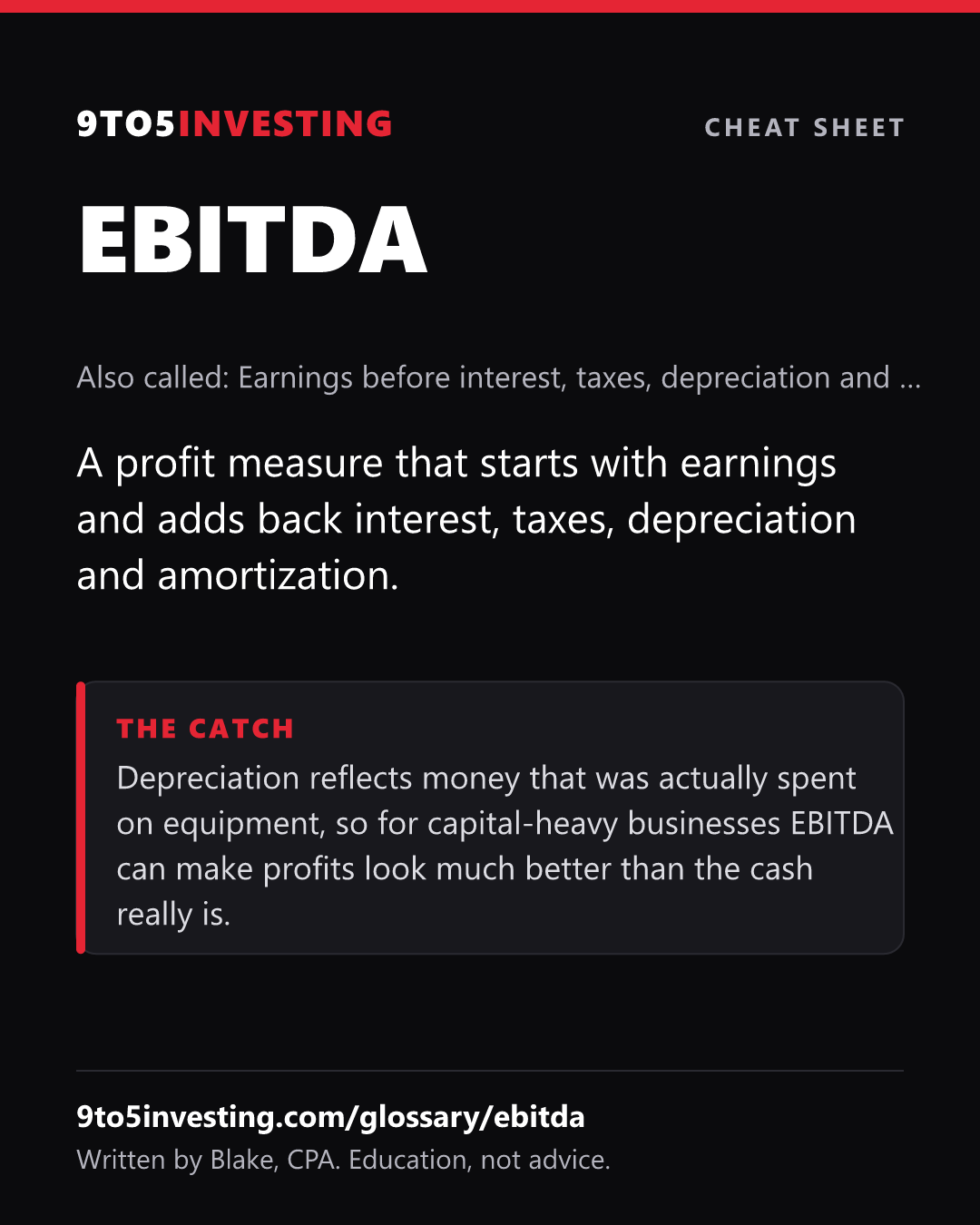
Free to save and share. Tap the image to open it full size.
Related terms
Enterprise value Operating margin Free cash flow Adjusted earnings
This is education, not tax or investment advice. I'm a CPA, but I'm not your CPA. Full disclaimer.