
Glossary·Written by a CPA
Operating margin
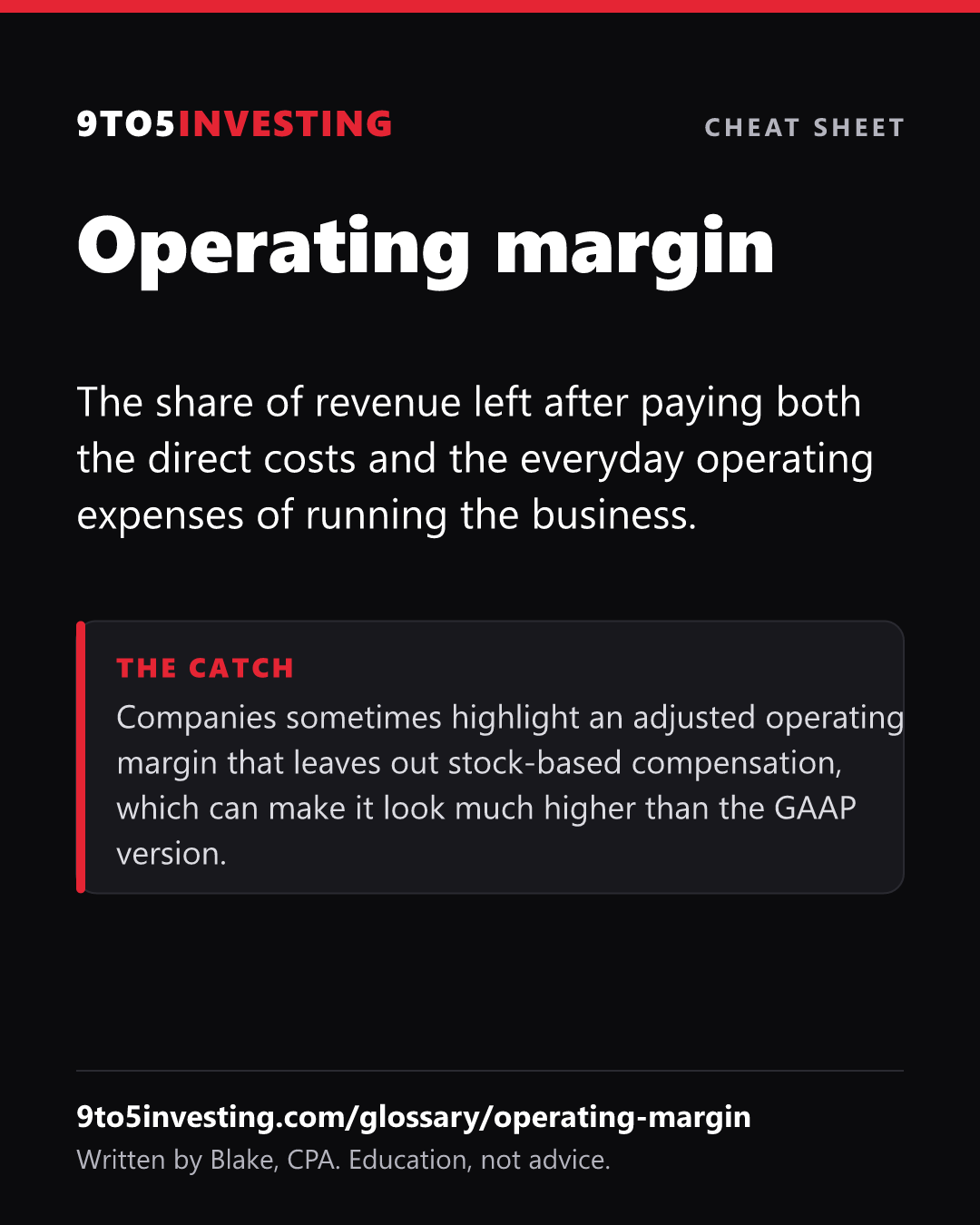
The share of revenue left after paying both the direct costs and the everyday operating expenses of running the business.
Operating margin is operating income divided by revenue. Operating income is basically just gross profit minus operating expenses, like salaries, research and development, marketing and rent, but before interest and taxes.
So if gross margin tells you how profitable each sale is, operating margin tells you how profitable the whole business is once you pay for everything it takes to run it.
For you, watching operating margin over time shows whether a company is getting more efficient as it grows. When revenue grows faster than expenses, margins expand, and that's often what investors call operating leverage.
Example. As an example, a company has $1,000 million of revenue, $600 million of gross profit and $450 million of operating expenses. Operating income is $600 million minus $450 million, which is $150 million, and operating margin is $150 million divided by $1,000 million, which is 15%.
The catch. Companies sometimes highlight an adjusted operating margin that leaves out stock-based compensation, which can make it look much higher than the GAAP version.
Where I talk about it
- SpaceX Q3 Earnings: Elon Says $1 Trillion a Year by 2027. Here's the Math. at 2:21
- Anthropic Just Filed for Its IPO—How Big Is the Opportunity? at 3:29
- Tesla Stock at $480? The SpaceX Merger Math (TSLA) at 1:51
- Tesla Stock at $344? The SpaceX Merger Math Just Broke (TSLA) at 9:57
- APP Stock: Sales Up 55%, Stock Down 60%. What Broke? at 4:32
- SMCI Stock: Why This $34 AI Stock Has a $57 Price Target at 1:52
- Ryan Cohen's GameStop Bet Is Bigger Than Video Games at 2:15
- Amazon & Google Stock: AI Bubble Beginning to Pop or Deal of the Year? at 1:47
Cheat sheet
Free to save and share. Tap the image to open it full size.
Related terms
This is education, not tax or investment advice. I'm a CPA, but I'm not your CPA. Full disclaimer.