
Glossary·Written by a CPA
Gross margin
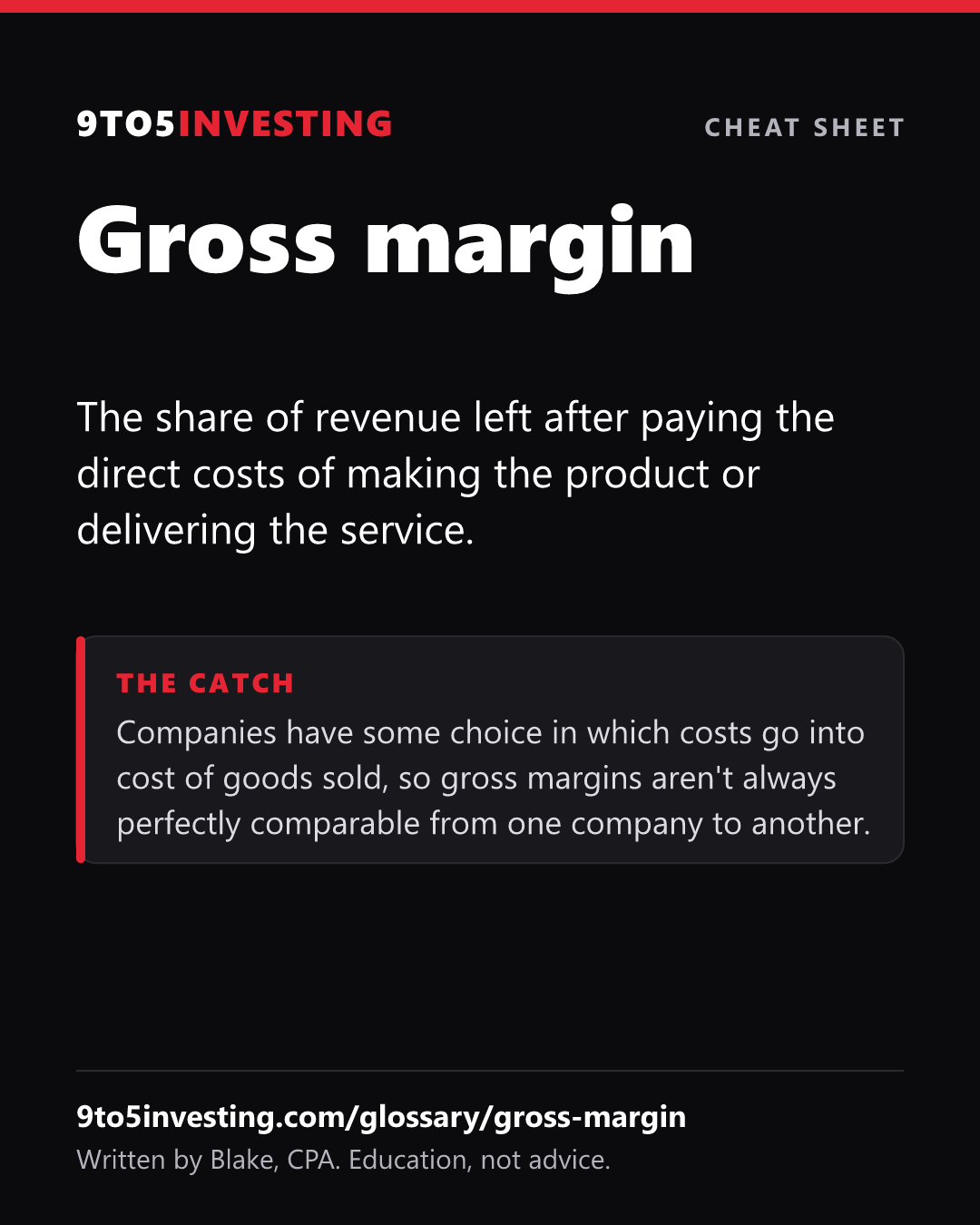
The share of revenue left after paying the direct costs of making the product or delivering the service.
Gross margin is gross profit divided by revenue, and gross profit is basically just revenue minus the cost of goods sold, which is the direct cost of making what the company sells.
Think of a coffee shop. If a latte sells for $5 and the coffee, milk and cup cost $1.50, the gross profit is $3.50, before rent, wages for the manager, or marketing.
For you, gross margin tells you something about the business model and pricing power. Software companies often have very high gross margins, while grocery stores and car makers tend to have much thinner ones, and a margin that keeps slipping can mean rising costs or more competition.
Example. As an example, a company has $1,000 million of revenue and $400 million of cost of goods sold. Gross profit is $1,000 million minus $400 million, which is $600 million, and gross margin is $600 million divided by $1,000 million, which is 60%.
The catch. Companies have some choice in which costs go into cost of goods sold, so gross margins aren't always perfectly comparable from one company to another.
Where I talk about it
- Don't Buy the Next Big IPO Until You Check These 7 Things at 2:48
- SMCI Stock: Why This $34 AI Stock Has a $57 Price Target at 3:46
- NVIDIA Stock: Why I Wouldn’t Buy All at Once at 2:34
- AAOI Stock at $69: The $160 Target Before Earnings at 6:23
- This $2 AI Stock Just Announced $225 Million in Contracts. Read the Footnote. (BBAI Stock) at 3:57
- Anthropic IPO- Opportunity of the Year or AI Bubble? at 4:08
- SNOW Stock (42% DECLINE)- Why Warren Buffet LOVES Snowflake Stock at 4:05
- Aurora Stock (AUR): What Has to Go Right for $11.55? at 6:35
Cheat sheet
Free to save and share. Tap the image to open it full size.
Related terms
This is education, not tax or investment advice. I'm a CPA, but I'm not your CPA. Full disclaimer.