
Glossary·Written by a CPA
Free cash flow
Also called: FCF
The cash a business generates from operations after paying for the equipment and investments it needs to keep running.
Free cash flow is basically just operating cash flow minus capital expenditures, which are the dollars spent on things like buildings, equipment and data centers. It's the cash left over that the company could use to pay down debt, pay dividends, buy back shares or invest in growth.
Think of it like your paycheck after the bills that keep your life running... rent, the car payment, groceries. What's left is what you can actually choose what to do with.
For you, free cash flow is harder to dress up than earnings, because it's tied to actual cash moving in and out. A company that reports profits year after year but never produces free cash flow deserves some extra questions.
Example. As an example, say a company has $800 million of operating cash flow and spends $300 million on capital expenditures. Free cash flow is $800 million minus $300 million, which is $500 million.
The catch. Many companies report free cash flow without subtracting stock-based compensation, which isn't cash but is still a real cost to shareholders through dilution.
Where I talk about it
- Amazon & Google Stock: AI Bubble Beginning to Pop or Deal of the Year? at 3:23
- AMD Stock at $520? The $17 Billion Guide Explained at 4:18
- TSLA vs SPCX: Which Stock Should You Own? at 0:00
- Don't Buy the Next Big IPO Until You Check These 7 Things at 3:50
- APP Stock: Sales Up 55%, Stock Down 60%. What Broke? at 4:49
- NVIDIA Stock: Why I Wouldn’t Buy All at Once at 1:04
- SMCI Stock: Why This $34 AI Stock Has a $57 Price Target at 6:52
- AAOI Stock at $69: The $160 Target Before Earnings at 2:35
Cheat sheet
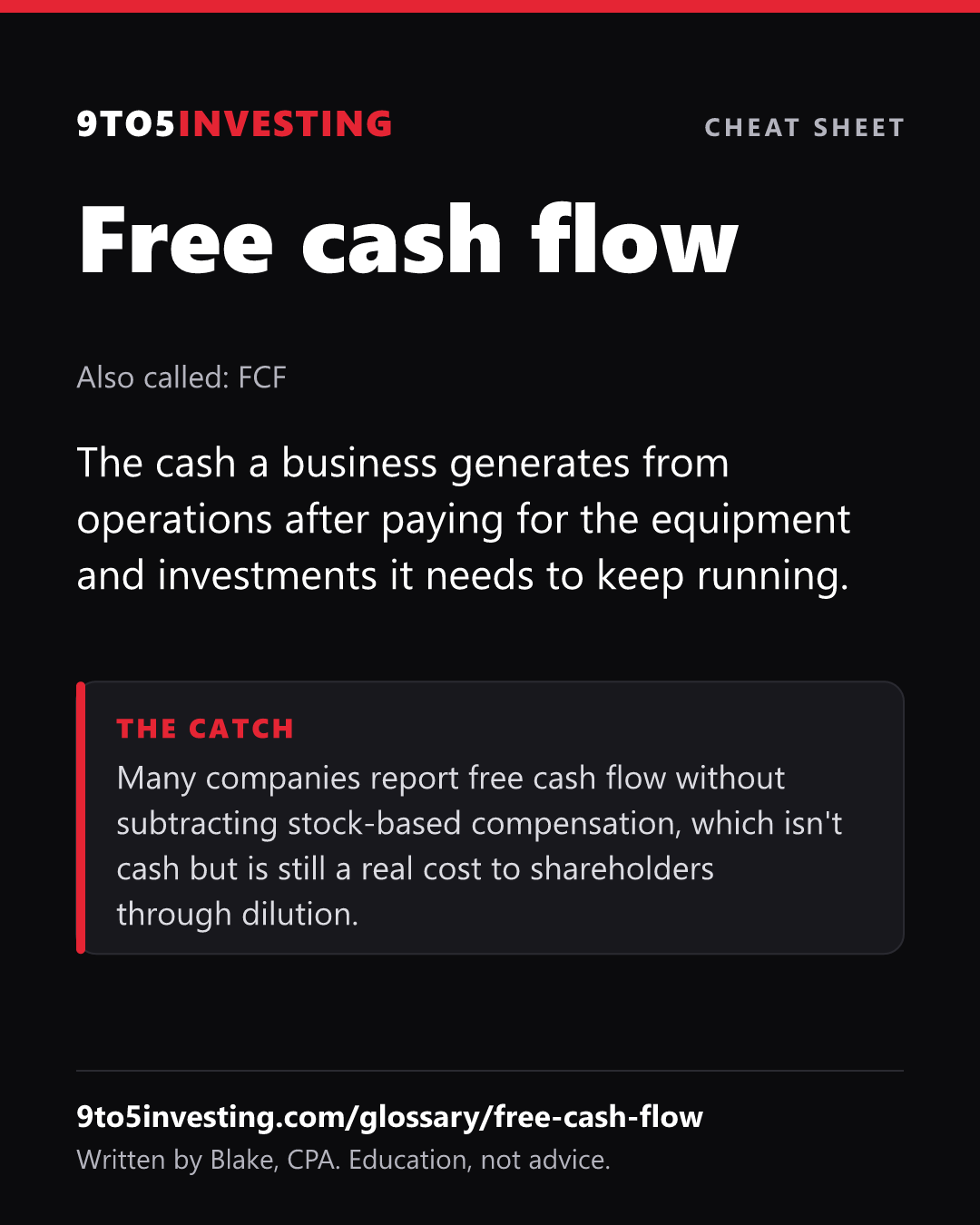
Free to save and share. Tap the image to open it full size.
Related terms
This is education, not tax or investment advice. I'm a CPA, but I'm not your CPA. Full disclaimer.