
Glossary·Written by a CPA
Dividend
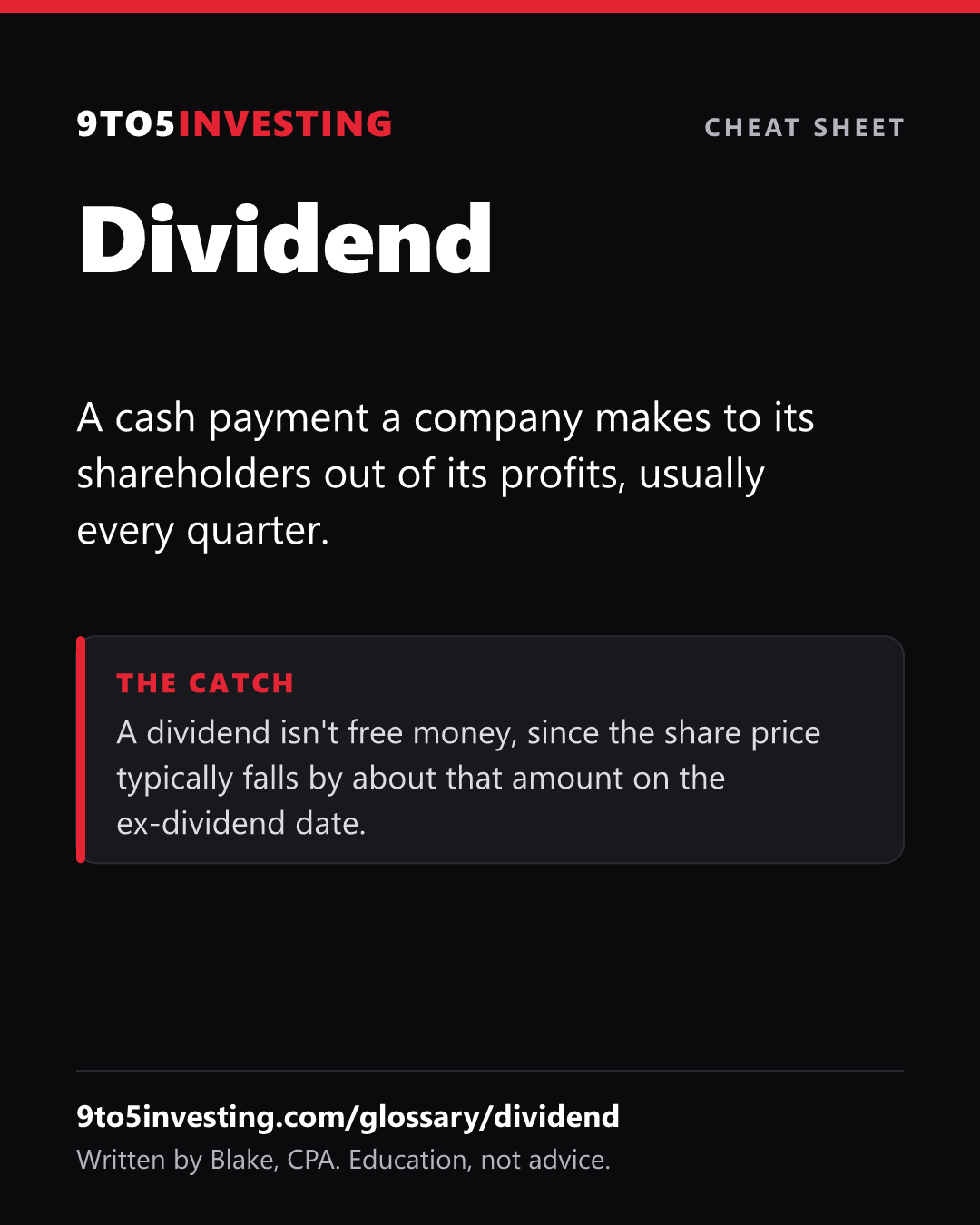
A cash payment a company makes to its shareholders out of its profits, usually every quarter.
A dividend is a payment a company sends to shareholders, which basically just means it's sharing some of its profits in cash instead of keeping it all to reinvest. Most US companies that pay one do it quarterly.
There are a few dates that matter. To get the dividend, you need to own the stock before the ex-dividend date, and on that date the stock price usually drops by roughly the amount of the dividend, because that cash is leaving the company.
For tax purposes, many dividends count as qualified dividends, which are taxed at the lower long-term capital gains rates, as long as you've held the stock for more than 60 days during the 121-day window around the ex-dividend date. Other dividends are taxed at ordinary income rates.
For you, a dividend is a choice the company makes, not a promise. Boards can cut or suspend it, and that usually happens when the business is under pressure.
The catch. A dividend isn't free money, since the share price typically falls by about that amount on the ex-dividend date.
Where I talk about it
- 5 Dividend Stocks to Buy and Hold Forever at 0:00
- TSLA vs SPCX: Which Stock Should You Own? at 9:20
- Covered Call ETFs Explained (QYLD, JEPI, JEPQ) at 4:41
- Tax-Loss Harvesting: What a $6,000 Loss Can Actually Save You at 3:34
- Backdoor Roth IRA Explained (Step by Step Process) at 5:00
- Starbucks Stock Analysis (SBUX)- Is Starbucks Stock a Buy in 2020? at 0:57
- Microsoft Stock Analysis (MSFT)- A Buy at ALL TIME Highs (2020)? at 0:58
Cheat sheet
Free to save and share. Tap the image to open it full size.
Related terms
This is education, not tax or investment advice. I'm a CPA, but I'm not your CPA. Full disclaimer.