
Glossary·Written by a CPA
Dividend yield
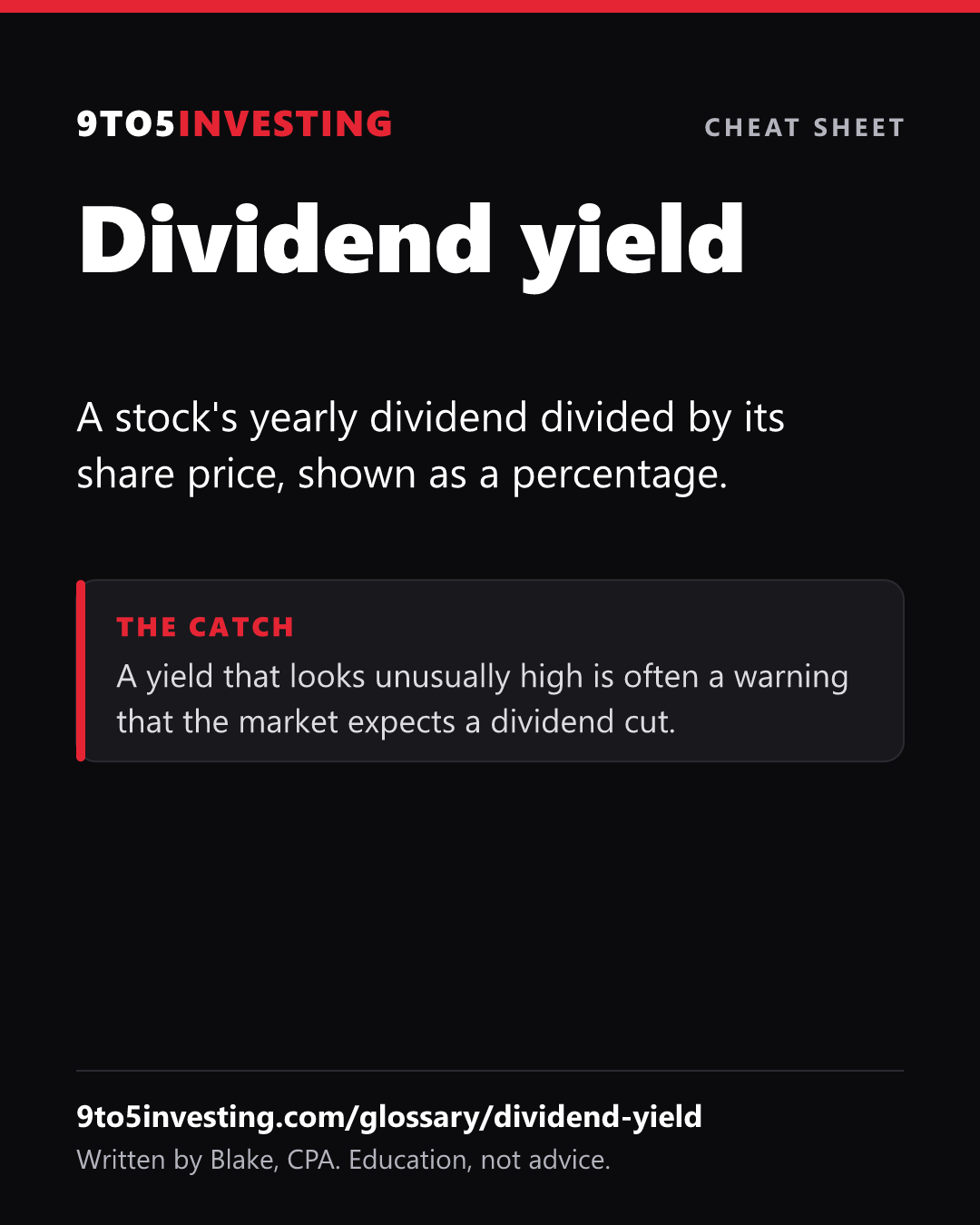
A stock's yearly dividend divided by its share price, shown as a percentage.
Dividend yield tells you how much a company pays in dividends each year compared to what the stock costs, which basically just means it's the dividend expressed as a percentage of the price.
Because price is in the bottom of the math, the yield goes up when the stock falls. So a really high yield can be a sign the market thinks the dividend is in trouble, rather than a sign of a great deal.
For you, it's worth checking whether the company's free cash flow actually covers the dividend. A payout that's bigger than the cash the business brings in can't last forever.
Example. As an example, say a stock costs $50 and pays $0.50 a quarter. The yearly dividend is $0.50 times 4, which is $2. The yield is $2 divided by $50, which is 4%.
The catch. A yield that looks unusually high is often a warning that the market expects a dividend cut.
Where I talk about it
- 5 Dividend Stocks to Buy and Hold Forever at 0:45
- Covered Call ETFs Explained (QYLD, JEPI, JEPQ) at 0:54
Cheat sheet
Free to save and share. Tap the image to open it full size.
Related terms
This is education, not tax or investment advice. I'm a CPA, but I'm not your CPA. Full disclaimer.