
Glossary·Written by a CPA
EPS
Also called: Earnings per share
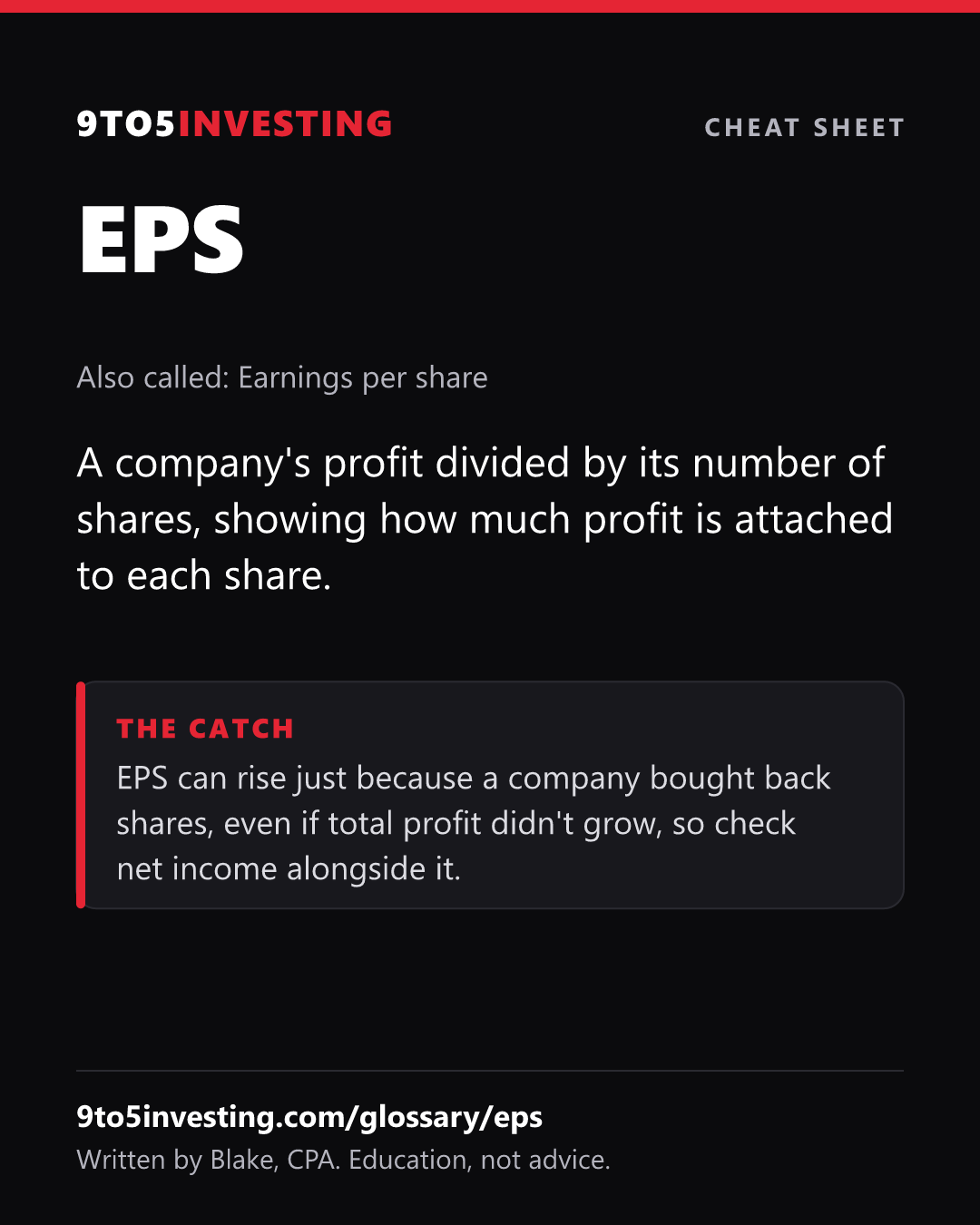
A company's profit divided by its number of shares, showing how much profit is attached to each share.
EPS, or earnings per share, is the company's net income divided by its shares outstanding, which basically just means how much of the profit belongs to each share you own.
You'll usually see two versions. Basic EPS uses the shares that exist today, and diluted EPS also counts shares that could be created from things like stock options and convertible bonds. Diluted EPS is usually the one people quote.
For you, EPS growth over time is one of the cleaner ways to see whether a business is getting more profitable for shareholders, because it accounts for both the profit and the share count.
Example. As an example, if a company earns $500 million of net income and has 250 million shares, EPS is $500 million divided by 250 million, which is $2.00 a share.
The catch. EPS can rise just because a company bought back shares, even if total profit didn't grow, so check net income alongside it.
Where I talk about it
- APP Stock: Sales Up 55%, Stock Down 60%. What Broke? at 6:55
- AMD Stock at $520? The $17 Billion Guide Explained at 6:59
- Sandisk Stock Split: The Price-Target Trap to Avoid at 7:48
- Starbucks Stock Analysis (SBUX)- Is Starbucks Stock a Buy in 2020? at 6:15
Cheat sheet
Free to save and share. Tap the image to open it full size.
Related terms
This is education, not tax or investment advice. I'm a CPA, but I'm not your CPA. Full disclaimer.