
Glossary·Written by a CPA
Dilution
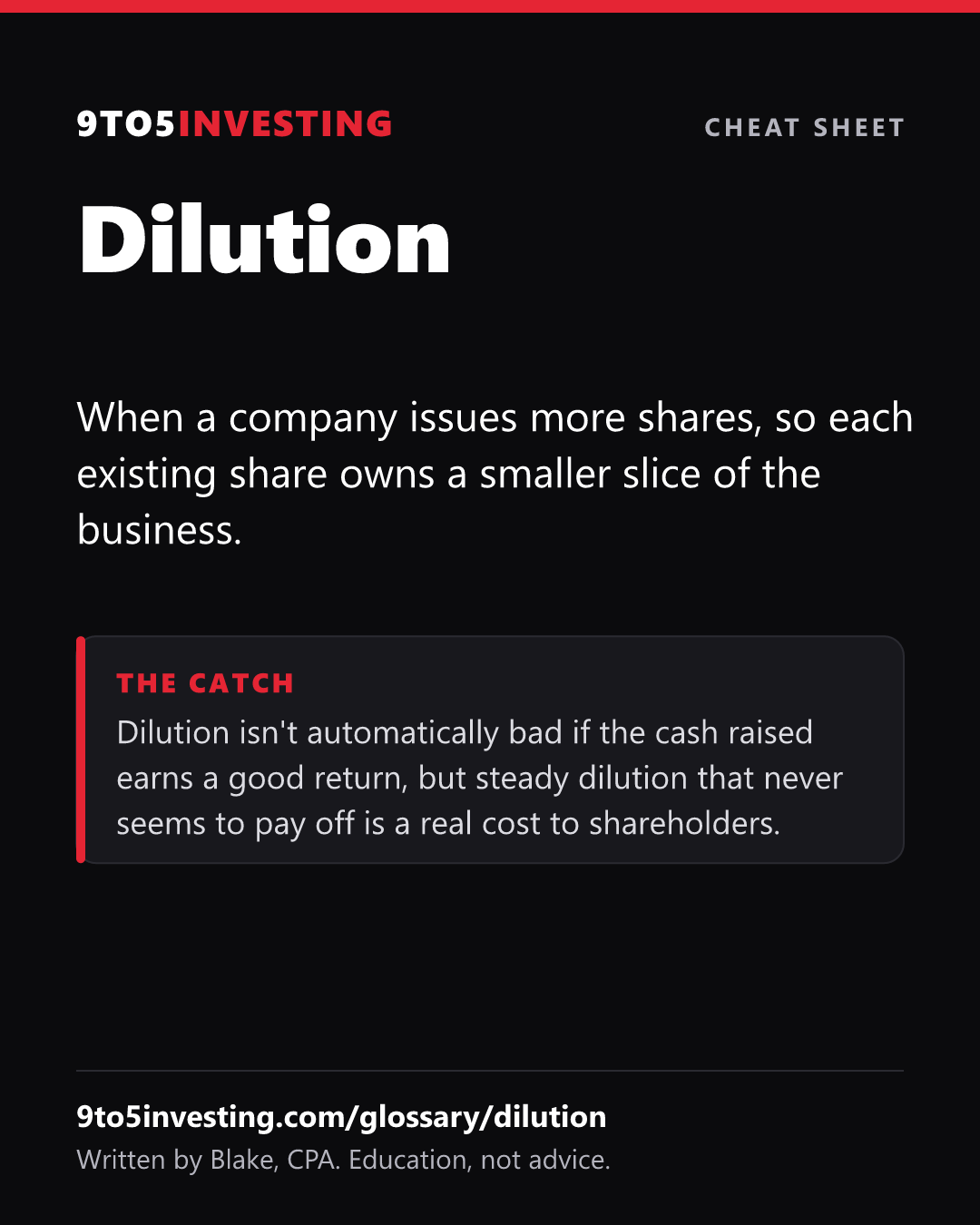
When a company issues more shares, so each existing share owns a smaller slice of the business.
Dilution is what happens when the total number of shares goes up, which basically just means your piece of the pie gets smaller even though you didn't sell anything. It's like a pizza that gets cut into 12 slices instead of 8... you still have one slice, but it's a smaller one.
New shares can come from a stock offering to raise cash, from stock-based compensation paid to employees, from convertible bonds turning into stock, or from using shares to pay for an acquisition.
For you, the easy check is the share count over time. If it keeps creeping up by a few percent every year, your ownership is shrinking, and earnings per share have to grow faster just to stand still.
Example. As an example, say a company has 100 million shares and you own 1 million, so you own 1%. If it issues 25 million new shares, there are now 125 million shares, and your 1 million shares are 1 million divided by 125 million, which is 0.8%.
The catch. Dilution isn't automatically bad if the cash raised earns a good return, but steady dilution that never seems to pay off is a real cost to shareholders.
Where I talk about it
- Don't Buy the Next Big IPO Until You Check These 7 Things at 0:46
- Anthropic Just Filed for Its IPO—How Big Is the Opportunity? at 4:29
- SMCI Stock: Why This $34 AI Stock Has a $57 Price Target at 5:28
- IonQ Stock: 113% Upside If Analysts Are Right? (IONQ) at 2:34
- 7 Stocks Analysts Say Could Double (One Could 4X) at 2:17
- SOUN Stock: Analysts Say This $4 AI Stock Could Triple at 2:56
- SoundHound Gets a Buy. Profitable AI Stock Cerence Gets a Hold. (CRNC) at 5:06
- Why This $6 AI Drone Stock Has an $11 Price Target (LTRX) (Lantronix Stock) at 5:02
Try it with your own numbers
Cheat sheet
Free to save and share. Tap the image to open it full size.
Related terms
This is education, not tax or investment advice. I'm a CPA, but I'm not your CPA. Full disclaimer.