
Glossary·Written by a CPA
Index fund
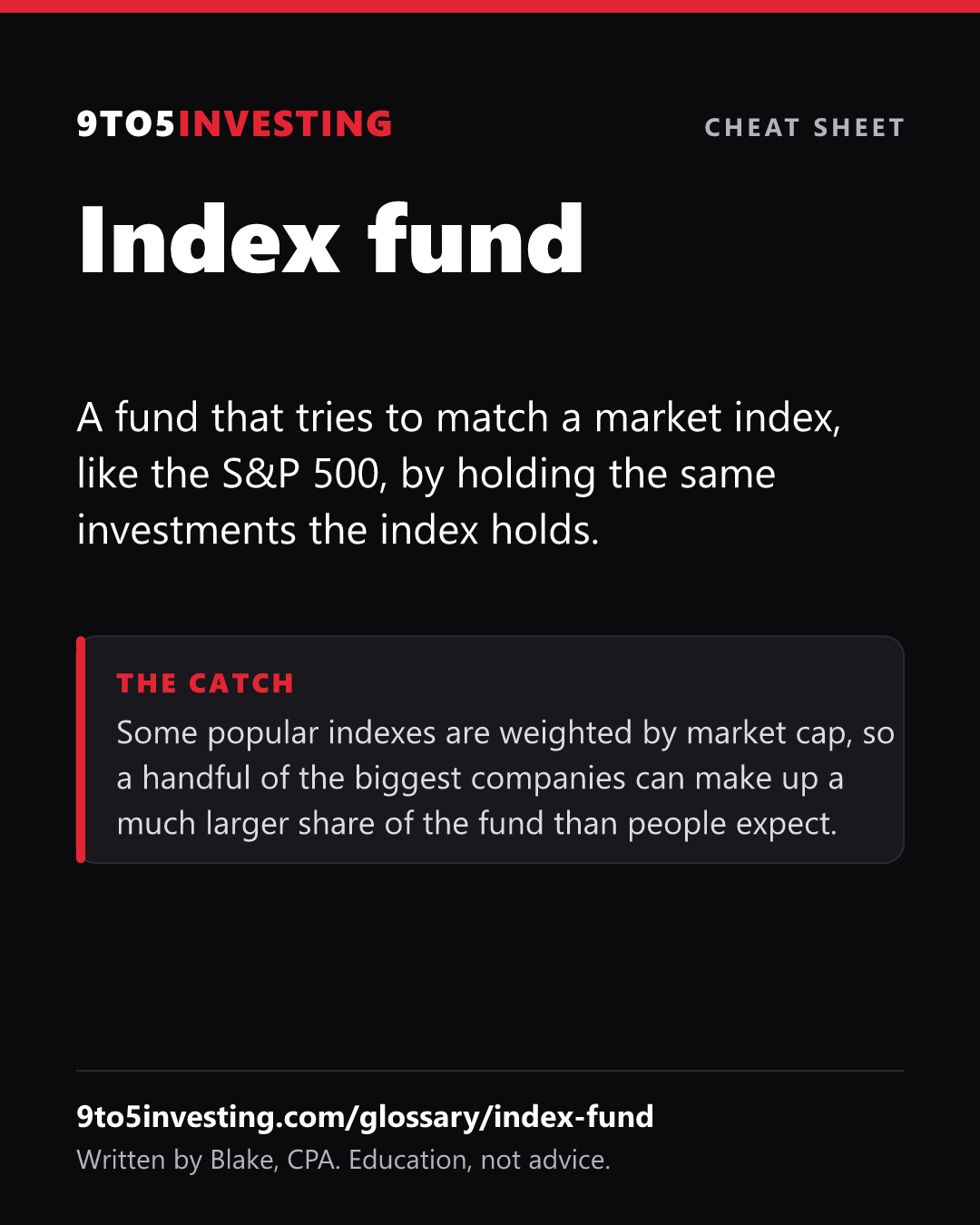
A fund that tries to match a market index, like the S&P 500, by holding the same investments the index holds.
An index fund basically just copies a list. Instead of a manager picking stocks, the fund holds whatever is in a particular index, like the S&P 500 or the total US stock market, in roughly the same proportions.
Because there's no one trying to outsmart the market, index funds tend to have very low expense ratios, and they don't trade much, which also helps keep costs down.
For you, the idea is that you're getting the market's return, minus a small fee, rather than trying to beat it. They can be mutual funds or ETFs... the structure is different but the idea is the same.
The catch. Some popular indexes are weighted by market cap, so a handful of the biggest companies can make up a much larger share of the fund than people expect.
Where I talk about it
- VOO Is 21% Nvidia, Apple and Microsoft. Is It Secretly an AI Bet? at 0:13
- SpaceX Stock: What Changes on December 8? at 2:42
- Tax-Loss Harvesting: What a $6,000 Loss Can Actually Save You at 5:09
- Amazon & Google Stock: AI Bubble Beginning to Pop or Deal of the Year? at 10:19
- Should I Sell My Stocks Now? Ask These 6 Questions First. at 3:13
- Stop Copying Buffett’s Stocks. Copy His Strategy. at 3:59
- Covered Call ETFs Explained (QYLD, JEPI, JEPQ) at 8:27
- 5 Dividend Stocks to Buy and Hold Forever at 10:23
Try it with your own numbers
Cheat sheet
Free to save and share. Tap the image to open it full size.
Related terms
This is education, not tax or investment advice. I'm a CPA, but I'm not your CPA. Full disclaimer.