
Glossary·Written by a CPA
ETF
Also called: Exchange-traded fund
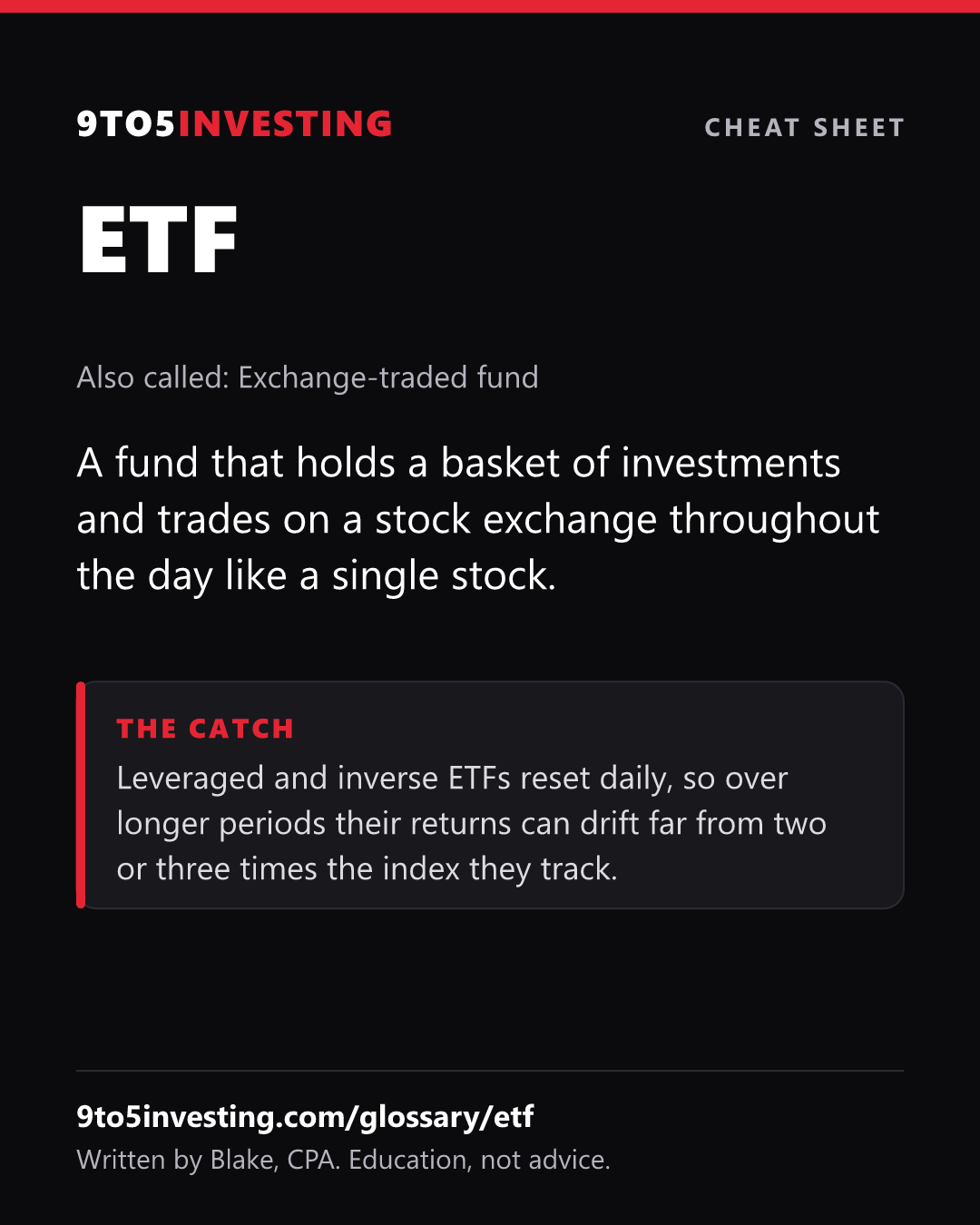
A fund that holds a basket of investments and trades on a stock exchange throughout the day like a single stock.
An ETF, or exchange-traded fund, is basically just a basket of stocks, bonds or other assets packaged into one thing you can trade on an exchange, the same way you'd trade a single share of a company.
Many ETFs are index funds that try to track something like the S&P 500, but not all of them. Some are actively managed, some focus on one narrow theme, and some use leverage or options to do something more complicated.
For you, the main things to check are what's actually inside it, what it costs through the expense ratio, and whether it's a simple fund or one of the more complex ones that behaves differently than you'd expect.
The catch. Leveraged and inverse ETFs reset daily, so over longer periods their returns can drift far from two or three times the index they track.
Cheat sheet
Free to save and share. Tap the image to open it full size.
Related terms
This is education, not tax or investment advice. I'm a CPA, but I'm not your CPA. Full disclaimer.