
Glossary·Written by a CPA
Dollar-cost averaging
Also called: DCA
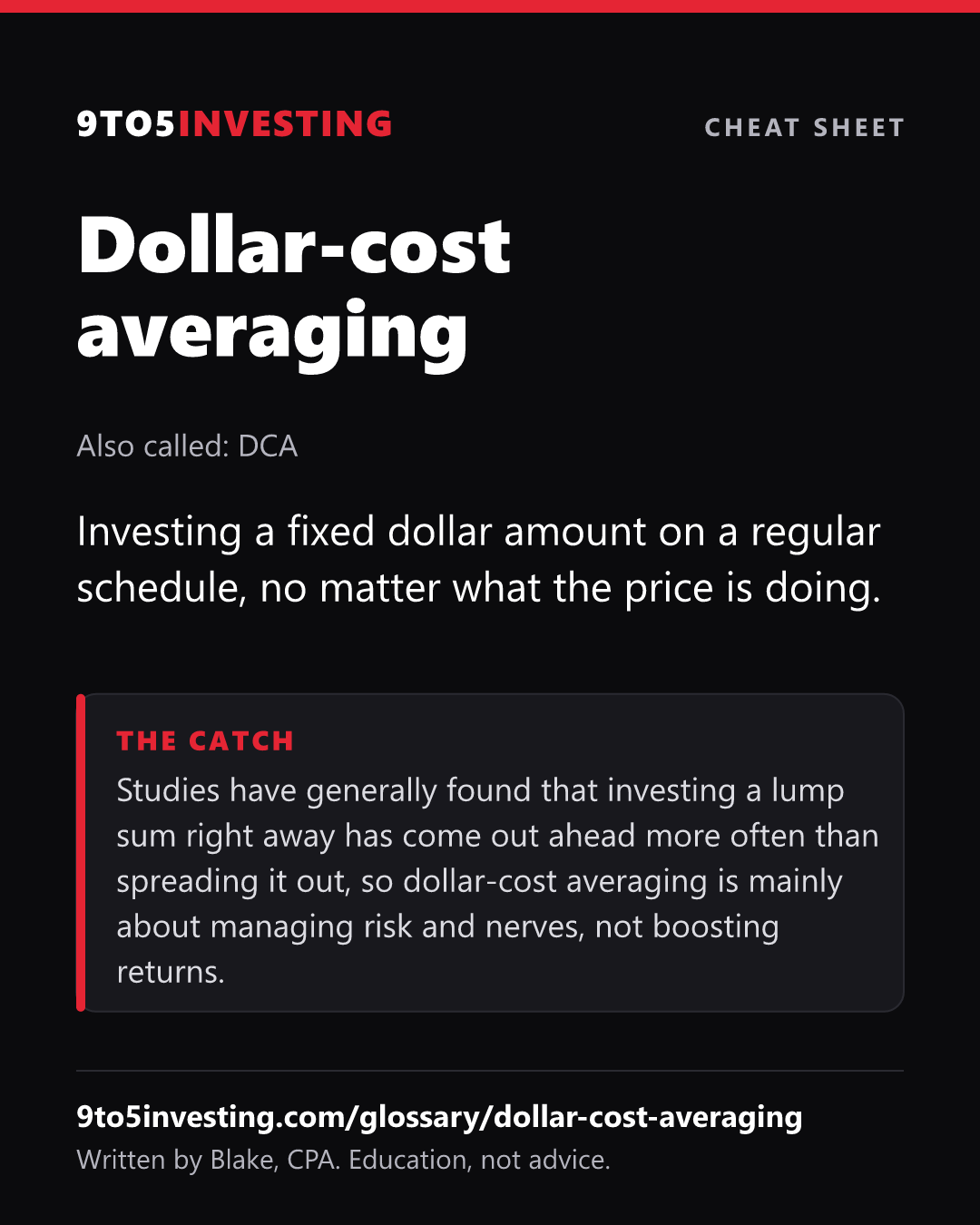
Investing a fixed dollar amount on a regular schedule, no matter what the price is doing.
Dollar-cost averaging basically just means putting the same amount of money in on a set schedule, like every payday, instead of trying to pick the perfect moment. If you contribute to a 401(k) out of every paycheck, you're already doing it.
Because the dollar amount stays the same, you end up getting more shares when the price is low and fewer when it's high, which takes a lot of the guesswork and emotion out of it.
For you, the biggest benefit is probably behavioral. It's a lot easier to stick with a plan when you don't have to decide each time whether now is a good time.
Example. As an example, you put in $100 each month. In month one the price is $10, so you get 10 shares. In month two it's $5, so you get 20 shares. You've invested $200 and own 30 shares, so your average cost is $200 divided by 30, which is about $6.67 a share, lower than the simple average price of $7.50.
The catch. Studies have generally found that investing a lump sum right away has come out ahead more often than spreading it out, so dollar-cost averaging is mainly about managing risk and nerves, not boosting returns.
Where I talk about it
- Buy the Dip vs Dollar Cost Averaging: A 20-Year Test at 0:11
- This $2 AI Stock Just Announced $225 Million in Contracts. Read the Footnote. (BBAI Stock) at 8:11
- Why This $2 AI Stock Has a $9 Price Target (RZLV) at 8:18
Try it with your own numbers
Cheat sheet
Free to save and share. Tap the image to open it full size.
Related terms
This is education, not tax or investment advice. I'm a CPA, but I'm not your CPA. Full disclaimer.