
Glossary·Written by a CPA
Expense ratio
The yearly fee a fund charges, shown as a percentage of the money you have invested in it.
The expense ratio is what a mutual fund or ETF charges each year to run the fund, which basically just means it's a percentage that gets taken out of the fund's assets. You never get a bill for it, it just quietly comes out of your returns.
Because it comes out every single year, small differences add up a lot over a long time, especially on a big balance.
For you, when two funds hold basically the same thing, the expense ratio is one of the few differences you can actually control.
Example. As an example, if you have $10,000 in a fund with a 0.05% expense ratio, the yearly cost is $10,000 times 0.0005, which is $5. The same $10,000 in a fund charging 1% costs $10,000 times 0.01, which is $100 a year.
The catch. The expense ratio doesn't include everything, like trading costs inside the fund or any advisory fee you pay on top.
Where I talk about it
Cheat sheet
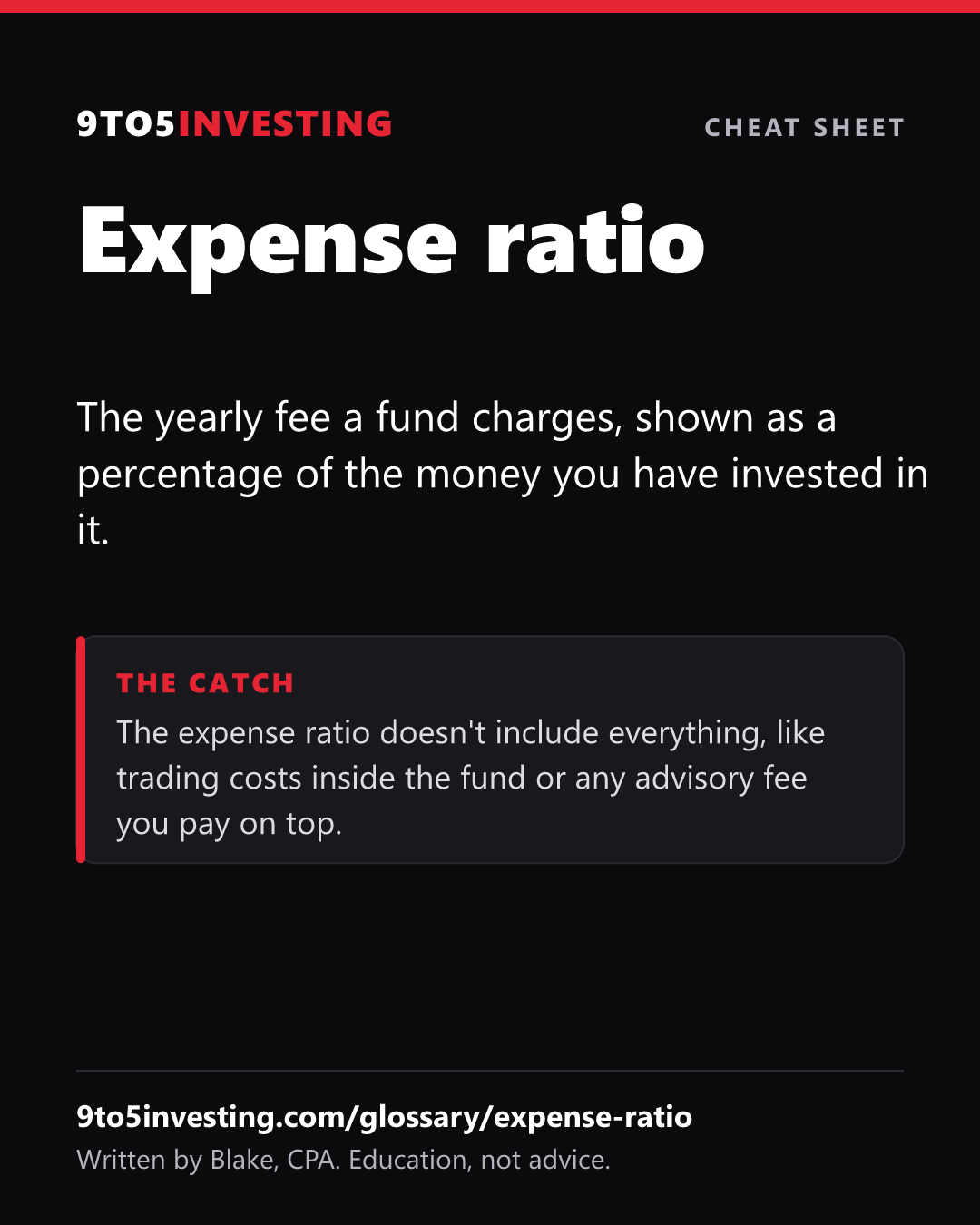
Free to save and share. Tap the image to open it full size.
Related terms
This is education, not tax or investment advice. I'm a CPA, but I'm not your CPA. Full disclaimer.