
Glossary·Written by a CPA
Market cap
Also called: Market capitalization
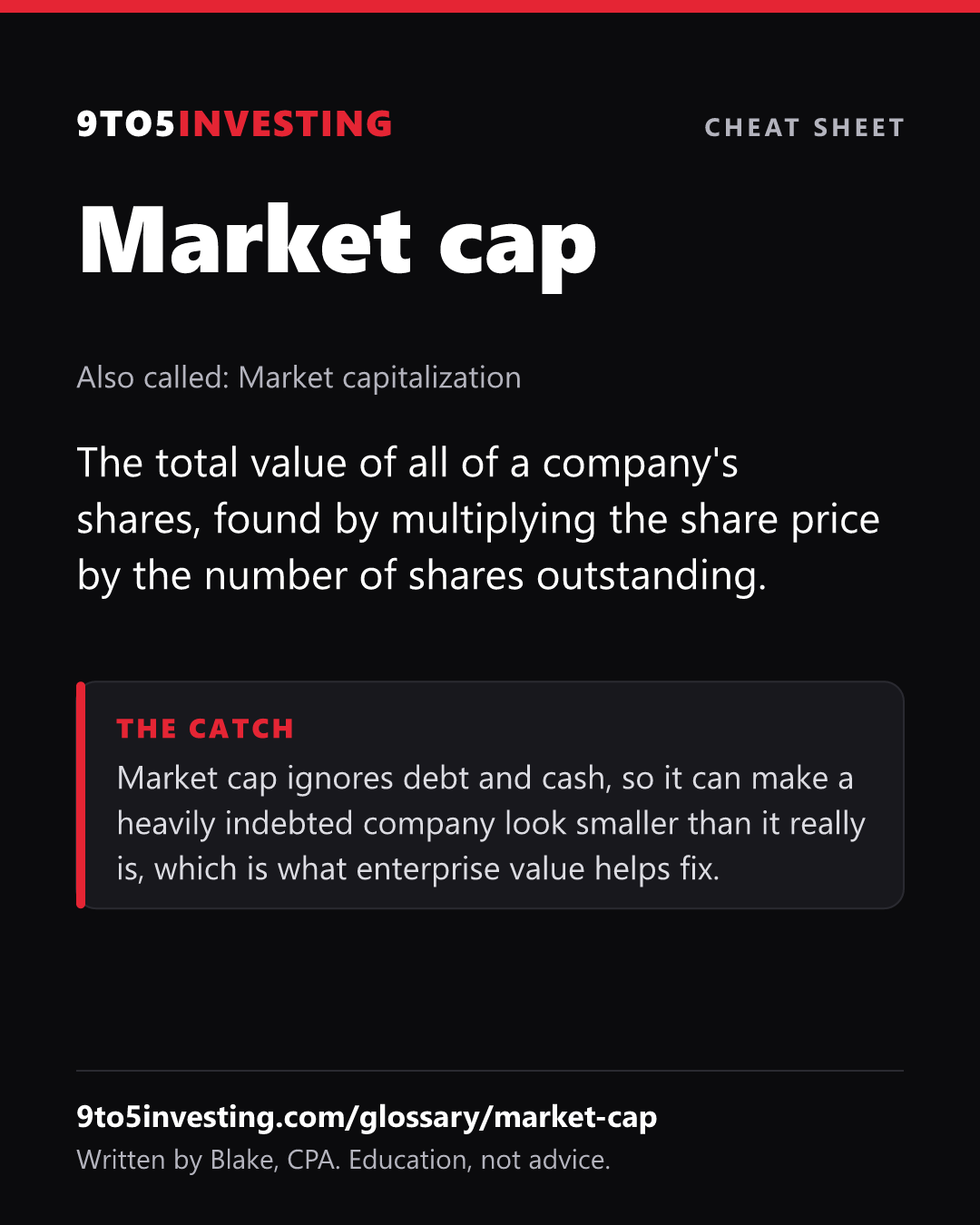
The total value of all of a company's shares, found by multiplying the share price by the number of shares outstanding.
Market cap is the share price times the number of shares, which basically just means what the stock market says the whole company's equity is worth right now.
This is the number to use when you're comparing the size of companies. A $20 stock isn't cheaper than a $500 stock in any meaningful way... what matters is how many shares there are and what the business is worth overall.
For you, market cap is also a quick reality check. If a company's market cap is many times bigger than its total yearly revenue, the stock is pricing in a lot of growth that hasn't happened yet.
Example. As an example, if a stock trades at $40 and there are 500 million shares outstanding, the market cap is $40 times 500 million, which is $20 billion.
The catch. Market cap ignores debt and cash, so it can make a heavily indebted company look smaller than it really is, which is what enterprise value helps fix.
Where I talk about it
- Anthropic IPO- Opportunity of the Year or AI Bubble? at 6:32
- Is NVDA Stock an URGENT BUY After the 4:1 Stock Split? (NVIDIA Stock Valuation) at 0:58
- Tesla Stock Analysis- Is Tesla Stock (TSLA) Still a Buy at ALL-TIME Highs? at 21:42
- Madrigal Pharmaceuticals (MDGL) Stock Analysis—The Solution to a $35 Billion Health Crisis (NASH)? at 0:31
Cheat sheet
Free to save and share. Tap the image to open it full size.
Related terms
This is education, not tax or investment advice. I'm a CPA, but I'm not your CPA. Full disclaimer.