
Glossary·Written by a CPA
Wash sale rule
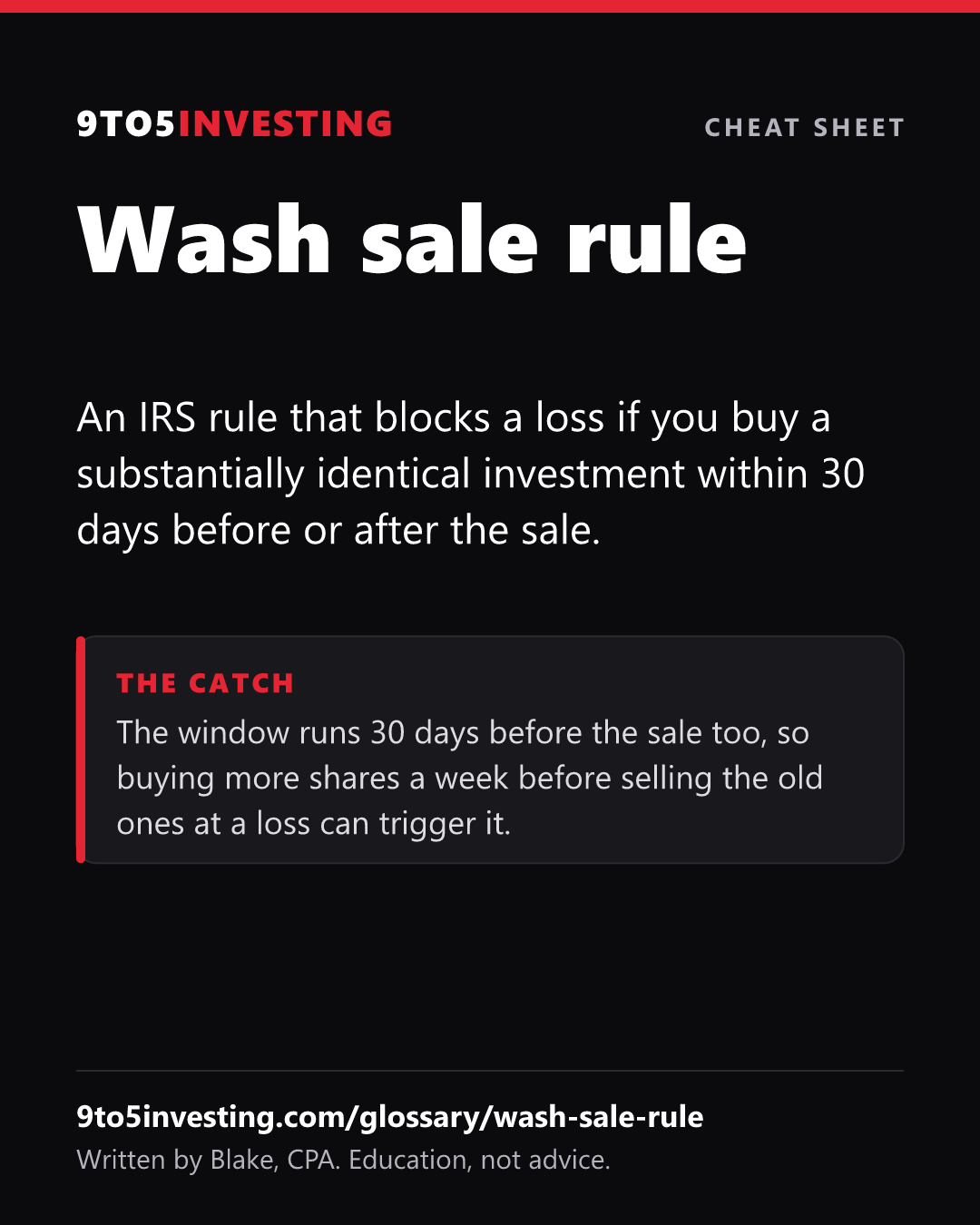
An IRS rule that blocks a loss if you buy a substantially identical investment within 30 days before or after the sale.
The wash sale rule says that if you sell something at a loss and buy the same or a substantially identical investment within 30 days before or 30 days after the sale, you can't claim that loss right now. That's basically just a 61-day window centered on the sale date.
The loss isn't gone forever in a normal account... it gets added to the cost basis of the new shares, so you get the benefit later when you sell those. But if the repurchase happens inside your IRA, the IRS has said the loss is effectively lost for good, since IRA basis doesn't work that way.
It also counts purchases made by your spouse, and things like automatic dividend reinvestment can accidentally trigger it. For you, the simplest way to stay clear is to watch the calendar on both sides of any sale at a loss.
Example. As an example, you buy 100 shares for $5,000 and sell them for $4,000, a $1,000 loss. Two weeks later you buy 100 shares back for $4,200. That's a wash sale, so the $1,000 loss is disallowed for now and added to your new cost basis, which becomes $4,200 plus $1,000, or $5,200.
The catch. The window runs 30 days before the sale too, so buying more shares a week before selling the old ones at a loss can trigger it.
Where I talk about it
- Tax-Loss Harvesting: What a $6,000 Loss Can Actually Save You at 0:47
- Is Day Trading Worth It? I Did the Math on the Hourly Pay at 6:39
- Should I Sell My Stocks Now? Ask These 6 Questions First. at 5:41
Try it with your own numbers
Cheat sheet
Free to save and share. Tap the image to open it full size.
Related terms
This is education, not tax or investment advice. I'm a CPA, but I'm not your CPA. Full disclaimer.