
Glossary·Written by a CPA
Tax-loss harvesting
Selling investments at a loss in a taxable account to offset capital gains and possibly some ordinary income.
Tax-loss harvesting basically just means selling an investment that's down so you can use the loss on your taxes. The loss can offset capital gains you've realized, and if losses are bigger than gains, up to $3,000 a year, or $1,500 if you're married filing separately, can offset ordinary income, with the rest carried forward.
People often reinvest the money into something similar so they stay invested, but it has to be different enough to avoid the wash sale rule.
For you, this only applies in regular taxable brokerage accounts. Inside an IRA or 401(k), gains and losses aren't taxed year to year, so there's nothing to harvest.
Example. As an example, say you have a $5,000 gain from one stock and a $3,000 loss in another. If you realize the loss, your net gain is $5,000 minus $3,000, which is $2,000, so you're only taxed on $2,000 instead of $5,000.
The catch. Harvesting a loss lowers your cost basis on whatever you reinvest in, so in many cases it pushes the tax down the road rather than making it disappear.
Where I talk about it
- Tax-Loss Harvesting: What a $6,000 Loss Can Actually Save You at 0:00
- Should I Sell My Stocks Now? Ask These 6 Questions First. at 5:27
Try it with your own numbers
Cheat sheet
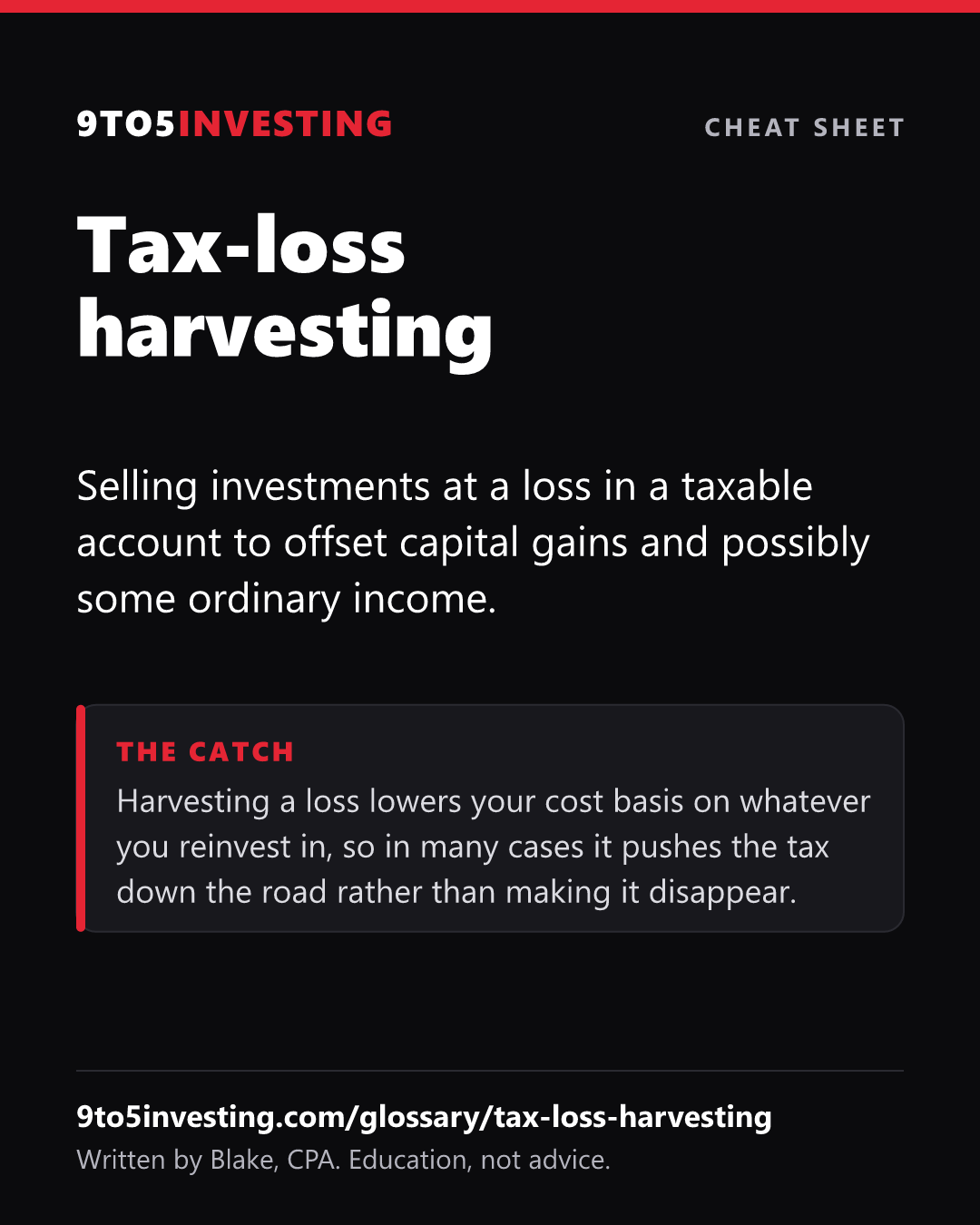
Free to save and share. Tap the image to open it full size.
Related terms
This is education, not tax or investment advice. I'm a CPA, but I'm not your CPA. Full disclaimer.