
Glossary·Written by a CPA
Roth IRA
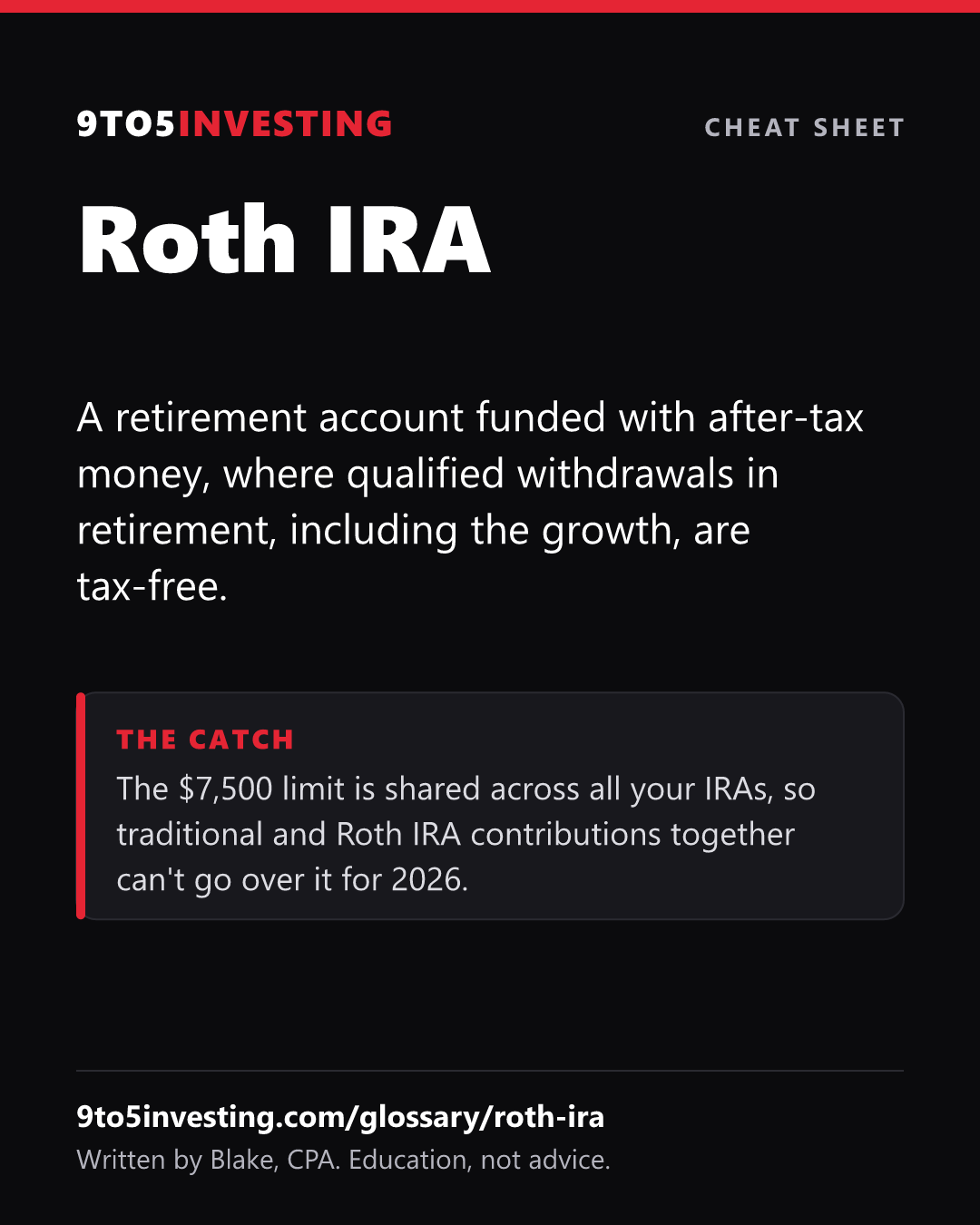
A retirement account funded with after-tax money, where qualified withdrawals in retirement, including the growth, are tax-free.
A Roth IRA is an individual retirement account where you pay tax on the money now, before it goes in, and then the growth can come out tax-free later. All that I mean is you skip the tax break today in exchange for not paying tax on the gains down the road.
For 2026, you can contribute up to $7,500, or $8,600 if you're 50 or older, and you can't contribute more than your earned income for the year. You have until the tax filing deadline, which is usually mid-April of the next year, to make contributions for 2026.
There are income limits. For 2026, the amount you can contribute directly starts phasing out at a modified adjusted gross income of $153,000 for single filers and $242,000 for married couples filing jointly, and it's gone completely at $168,000 and $252,000.
For you, the money you contributed can generally be taken back out at any time without tax or penalty, but earnings are only tax-free and penalty-free in a qualified withdrawal, which usually means you're at least 59 and a half and the account has been open for five years, with some exceptions.
The catch. The $7,500 limit is shared across all your IRAs, so traditional and Roth IRA contributions together can't go over it for 2026.
Where I talk about it
- Mega Backdoor Roth (Step by Step) at 0:17
- Amazon & Google Stock: AI Bubble Beginning to Pop or Deal of the Year? at 0:22
- Backdoor Roth IRA Explained (Step by Step Process) at 0:31
- Why This $2 AI Stock Has a $9 Price Target (RZLV) at 1:05
- Tax-Loss Harvesting: What a $6,000 Loss Can Actually Save You at 4:29
- PONY Stock Is $5. Why Do Analysts Say $20? at 5:21
Try it with your own numbers
Cheat sheet
Free to save and share. Tap the image to open it full size.
Related terms
This is education, not tax or investment advice. I'm a CPA, but I'm not your CPA. Full disclaimer.