
Glossary·Written by a CPA
Backdoor Roth IRA
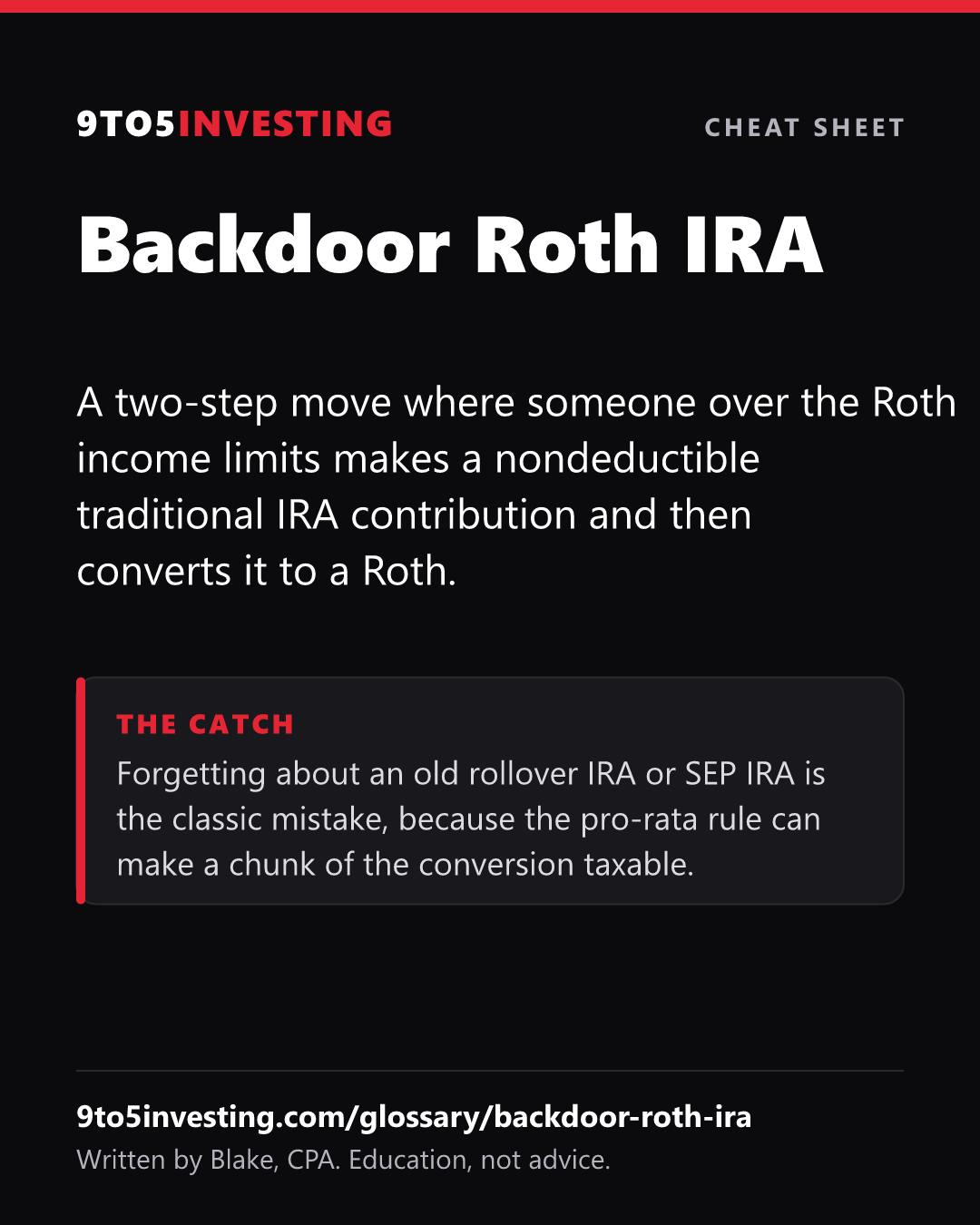
A two-step move where someone over the Roth income limits makes a nondeductible traditional IRA contribution and then converts it to a Roth.
A backdoor Roth IRA isn't a special type of account, it's a strategy. All that I mean is that if your income is too high to contribute to a Roth IRA directly, you can contribute to a traditional IRA without taking a deduction, and then convert that money into a Roth IRA. Conversions don't have an income limit, which is why this works.
For 2026, the contribution is still capped at the regular IRA limit, which is $7,500, or $8,600 if you're 50 or older. You report the nondeductible contribution and the conversion on Form 8606 with your tax return.
The big catch is the pro-rata rule. If you already have pre-tax money sitting in any traditional, SEP or SIMPLE IRA, the conversion gets taxed partly based on that balance, so the clean, tax-free version of this only really works when those other IRAs are empty or have been moved into an employer plan.
For you, this is one where it's worth running your actual numbers, or talking to a tax pro, before you do it, because the paperwork matters as much as the move itself.
The catch. Forgetting about an old rollover IRA or SEP IRA is the classic mistake, because the pro-rata rule can make a chunk of the conversion taxable.
Where I talk about it
- Mega Backdoor Roth (Step by Step) at 1:42
- Backdoor Roth IRA Explained (Step by Step Process) at 1:21
Try it with your own numbers
Cheat sheet
Free to save and share. Tap the image to open it full size.
Related terms
This is education, not tax or investment advice. I'm a CPA, but I'm not your CPA. Full disclaimer.