
Glossary·Written by a CPA
Pro-rata rule
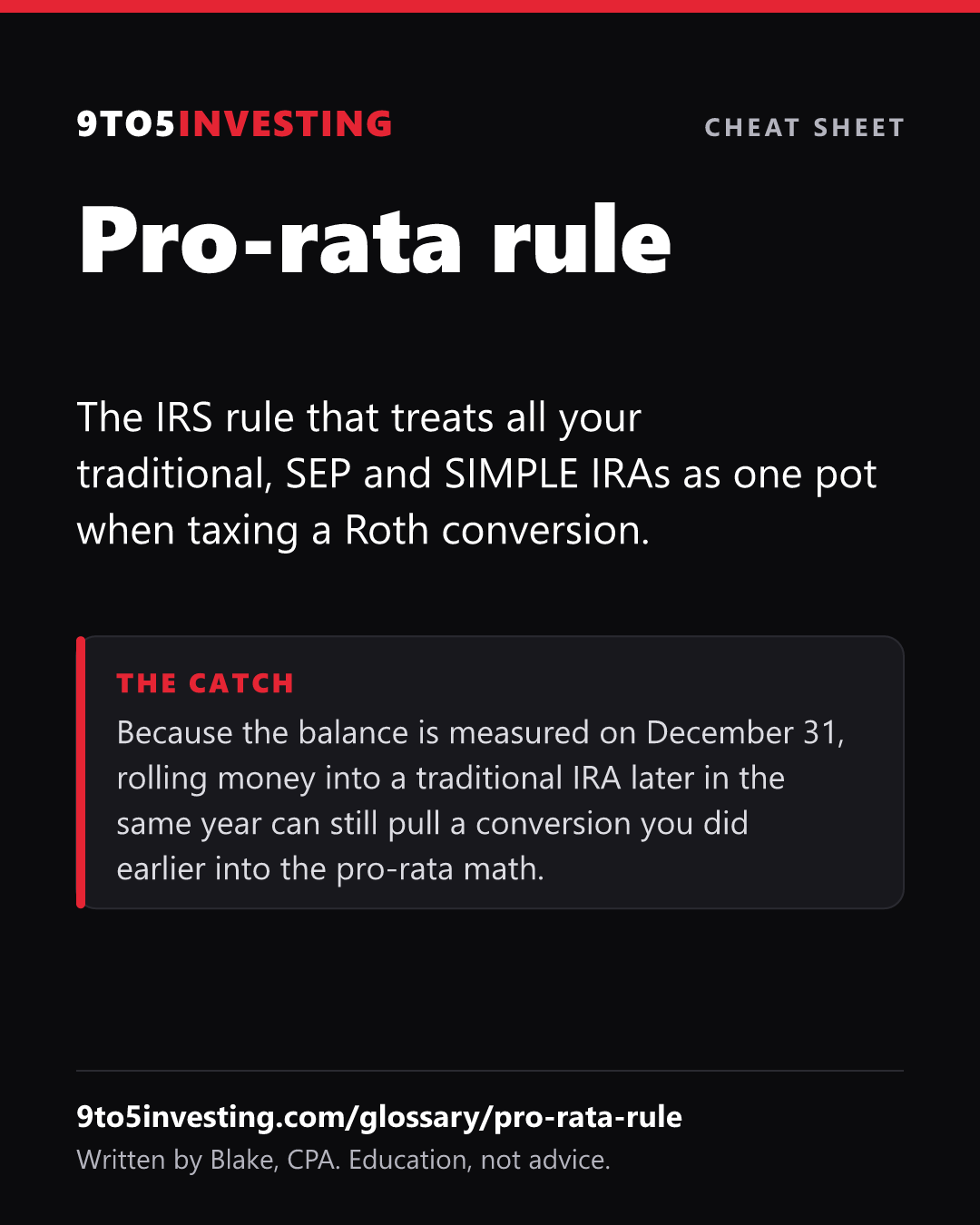
The IRS rule that treats all your traditional, SEP and SIMPLE IRAs as one pot when taxing a Roth conversion.
The pro-rata rule basically just means you can't pick and choose which dollars you convert to a Roth. If you have both after-tax money and pre-tax money across your IRAs, the IRS treats every conversion as a proportional mix of the two.
It's like pouring a cup of cream into a pitcher of coffee. Once it's mixed, you can't pour out just the cream... every cup you pour is part coffee, part cream.
The calculation uses the total value of all your traditional, SEP and SIMPLE IRAs as of December 31 of the year you convert, not the day you convert. Employer plans like a 401(k) aren't included, which is why some people roll pre-tax IRA money into their workplace plan first, if the plan allows it. Inherited IRAs aren't part of the pot either.
For you, this is the rule that decides whether a backdoor Roth is mostly tax-free or partly taxable, and it's reported on Form 8606.
Example. As an example, say you make a $7,500 nondeductible contribution for 2026, and you also have an old rollover IRA with $67,500 of pre-tax money. Your total IRA balance is $7,500 plus $67,500, which is $75,000, and your after-tax share is $7,500 divided by $75,000, which is 10%. If you convert $7,500, only 10% of it, or $750, is tax-free, and the other $6,750 is taxable income.
The catch. Because the balance is measured on December 31, rolling money into a traditional IRA later in the same year can still pull a conversion you did earlier into the pro-rata math.
Try it with your own numbers
Cheat sheet
Free to save and share. Tap the image to open it full size.
Related terms
This is education, not tax or investment advice. I'm a CPA, but I'm not your CPA. Full disclaimer.