
Glossary·Written by a CPA
Forward P/E
Also called: Forward price-to-earnings
A stock's price divided by analysts' estimate of its earnings per share for the next year.
Forward P/E is the same idea as the regular P/E ratio, except it uses expected earnings instead of past earnings. All that I mean is you divide today's price by what analysts think EPS will be over the next 12 months or the next fiscal year.
It's popular for fast-growing companies, because last year's earnings might be tiny compared to where the business is heading.
For you, the catch is that the bottom of the math is a forecast. If those estimates turn out too optimistic, the stock was never as cheap as the forward P/E made it look.
Example. As an example, say a stock costs $100, it earned $4 per share last year and analysts expect $5 next year. The trailing P/E is $100 divided by $4, which is 25. The forward P/E is $100 divided by $5, which is 20.
The catch. Forward estimates are usually based on adjusted earnings and can be cut quickly, so a low forward P/E depends entirely on the forecast holding up.
Where I talk about it
Cheat sheet
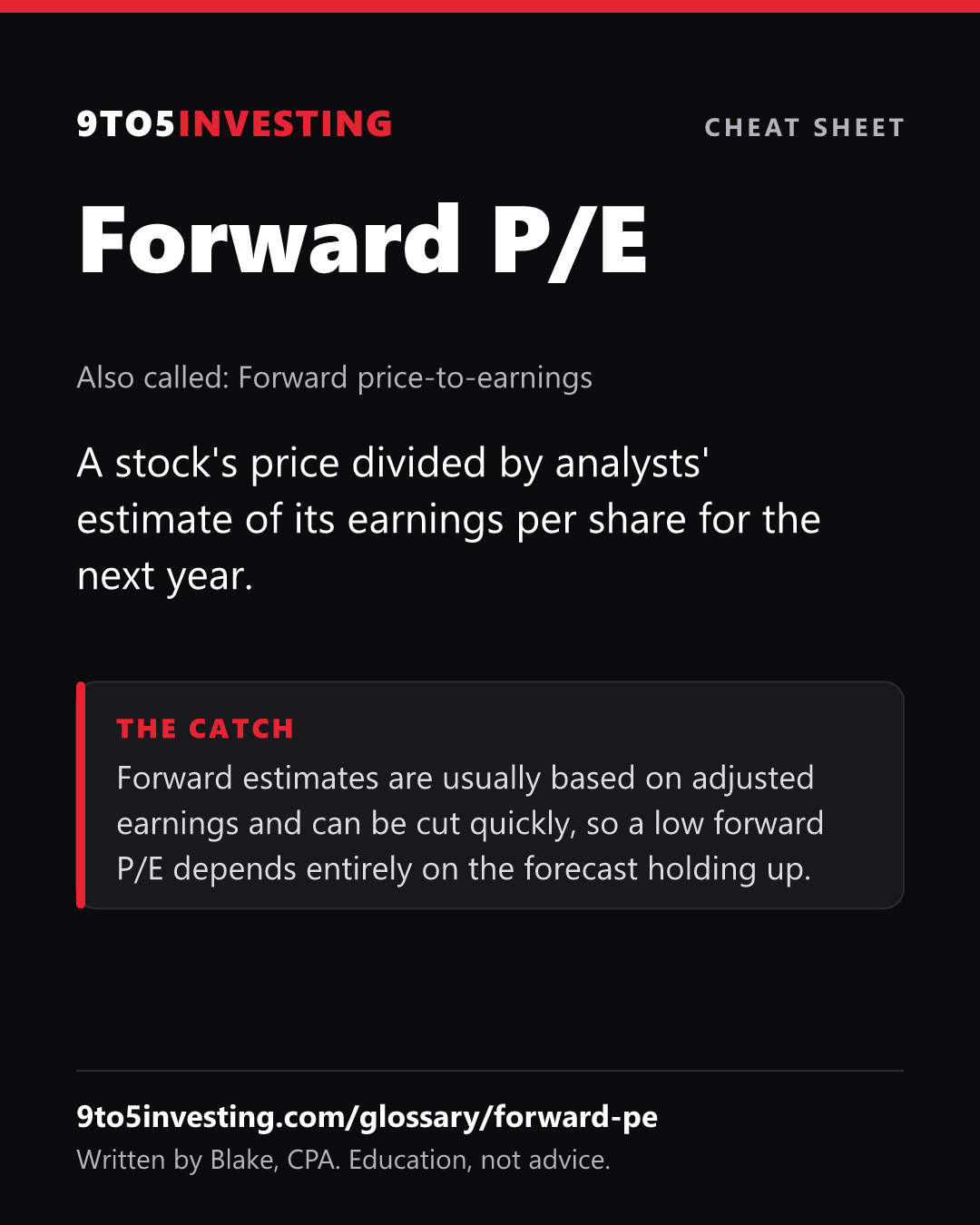
Free to save and share. Tap the image to open it full size.
Related terms
This is education, not tax or investment advice. I'm a CPA, but I'm not your CPA. Full disclaimer.