
Glossary·Written by a CPA
Reverse split
Also called: Reverse stock split
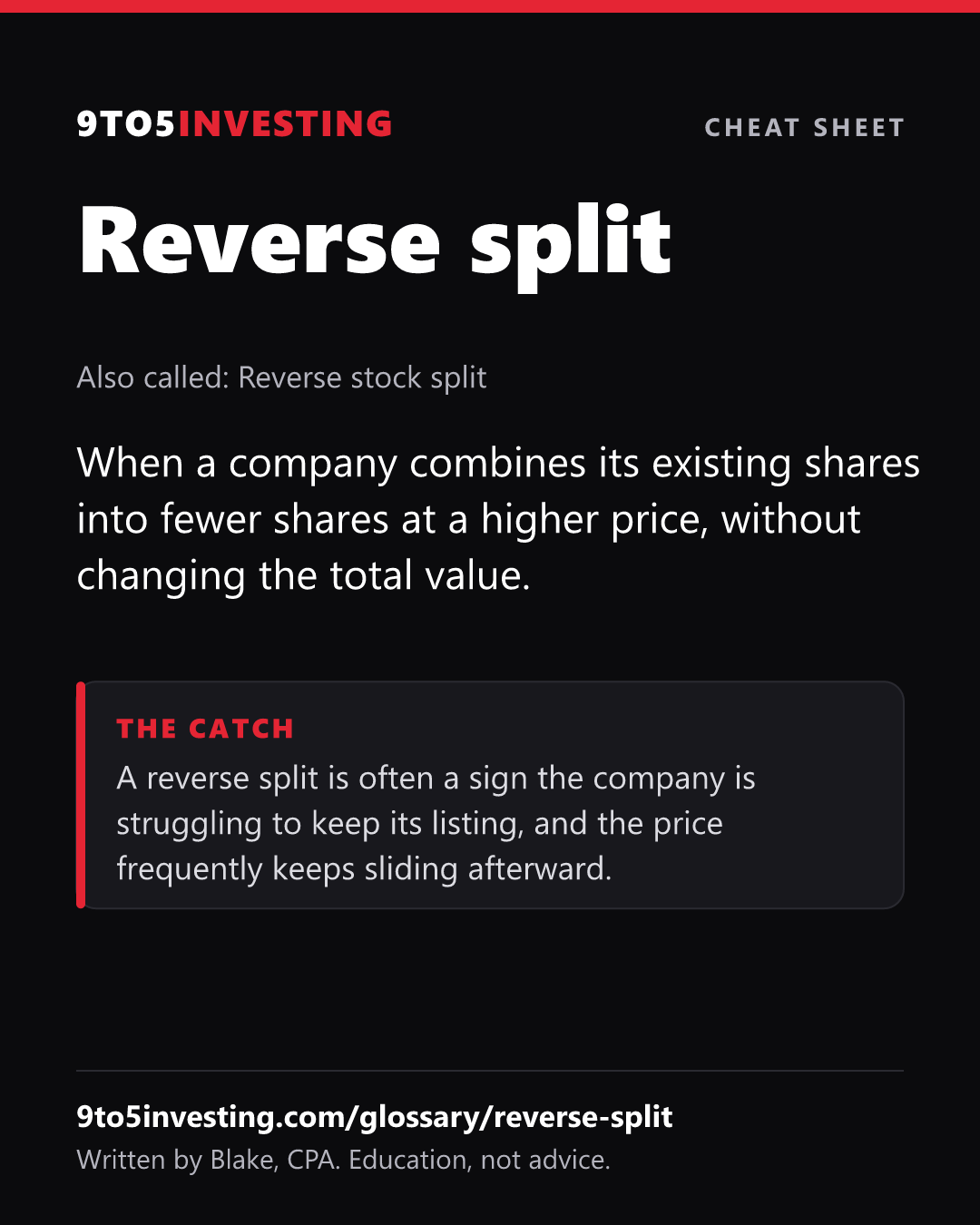
When a company combines its existing shares into fewer shares at a higher price, without changing the total value.
A reverse split basically just means the company swaps several of your shares for one new share. Your total value doesn't change on that day... you just have fewer shares at a higher price.
It's like trading ten $1 bills for a $10 bill. You don't have more money, it's just packaged differently.
Companies usually do this when the stock price has fallen a long way, often to stay above an exchange's minimum price, which for Nasdaq and the NYSE is $1. For you, it's worth knowing that it doesn't fix anything about the business itself, and it's sometimes followed by the company issuing more shares.
Example. As an example, say you own 1,000 shares at $0.50, which is worth $500. After a 1-for-10 reverse split, you own 1,000 divided by 10, which is 100 shares, at $0.50 times 10, which is $5 each. That's still 100 times $5, or $500.
The catch. A reverse split is often a sign the company is struggling to keep its listing, and the price frequently keeps sliding afterward.
Cheat sheet
Free to save and share. Tap the image to open it full size.
Related terms
This is education, not tax or investment advice. I'm a CPA, but I'm not your CPA. Full disclaimer.