Glossary·Written by a CPA
Options
Also called: Calls and puts
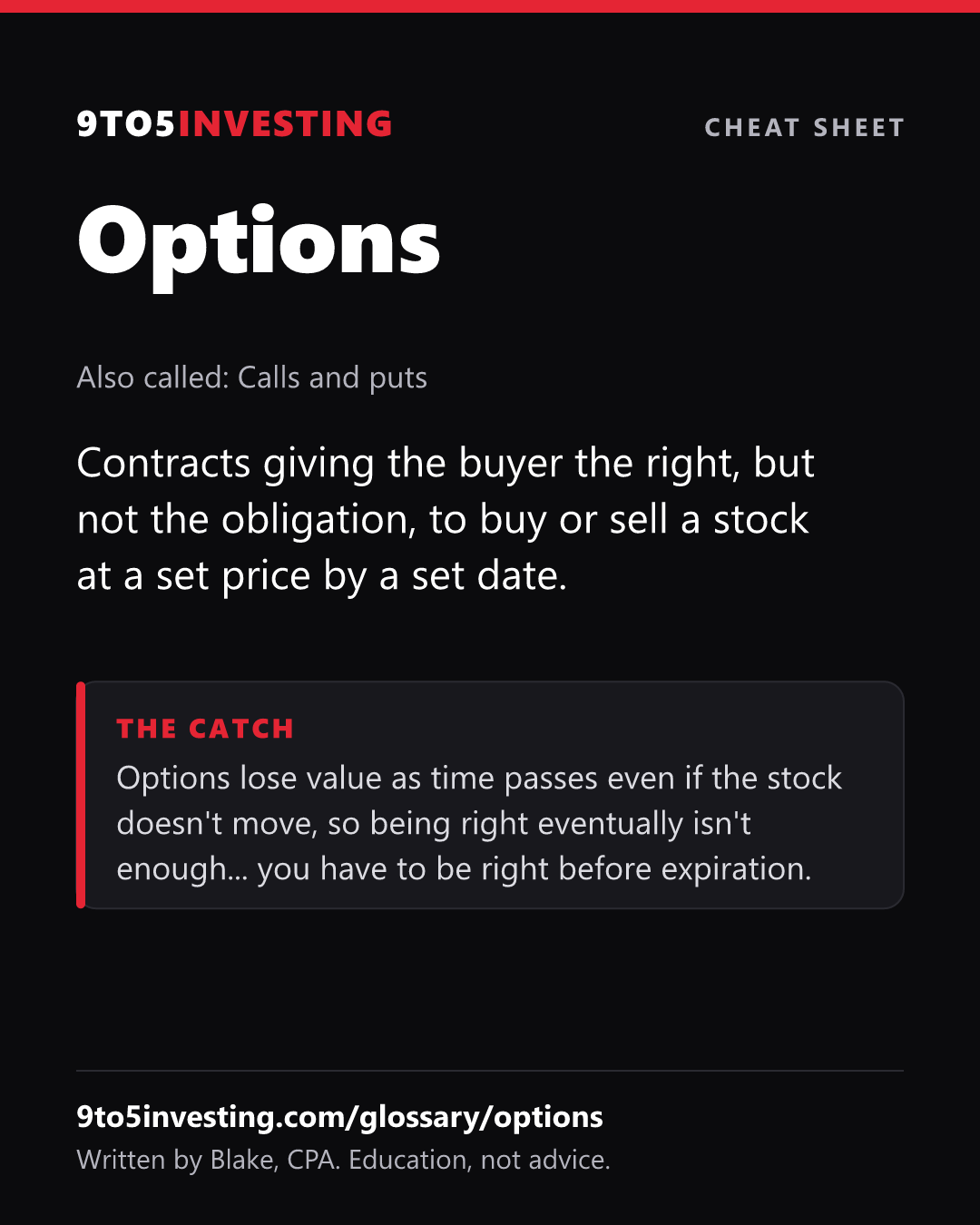
Contracts giving the buyer the right, but not the obligation, to buy or sell a stock at a set price by a set date.
An option is a contract tied to a stock. A call option gives the buyer the right to buy the stock at a set price, called the strike price, until the expiration date. A put option gives the buyer the right to sell at the strike price. In the US, one standard contract usually covers 100 shares.
The buyer pays a price for the contract called the premium, which basically just works like a nonrefundable deposit. If the stock doesn't move the way they need before expiration, the option can expire worthless and they lose the whole premium.
The person on the other side, the seller, collects the premium but takes on the obligation. Selling calls without owning the shares can have losses with no upper limit, which is why brokers require special approval for it.
For you, options are a much more complicated tool than shares, with time decay and volatility affecting the price, so it's worth understanding them well before touching them.
Example. As an example, say a call option has a $50 strike and costs $2 per share, so one contract costs $2 times 100, which is $200. If the stock is at $60 at expiration, the option is worth $60 minus $50, which is $10 per share, or $1,000 per contract, for a profit of $1,000 minus $200, which is $800. If the stock is at $48, the option expires worthless and the $200 is gone.
The catch. Options lose value as time passes even if the stock doesn't move, so being right eventually isn't enough... you have to be right before expiration.
Where I talk about it
- Short Squeeze Explained for Beginners at 9:11
- VOO Is 21% Nvidia, Apple and Microsoft. Is It Secretly an AI Bet? at 1:54
- This $2 AI Stock Just Announced $225 Million in Contracts. Read the Footnote. (BBAI Stock) at 2:04
Cheat sheet
Free to save and share. Tap the image to open it full size.
Related terms
This is education, not tax or investment advice. I'm a CPA, but I'm not your CPA. Full disclaimer.