
Glossary·Written by a CPA
Goodwill and impairment
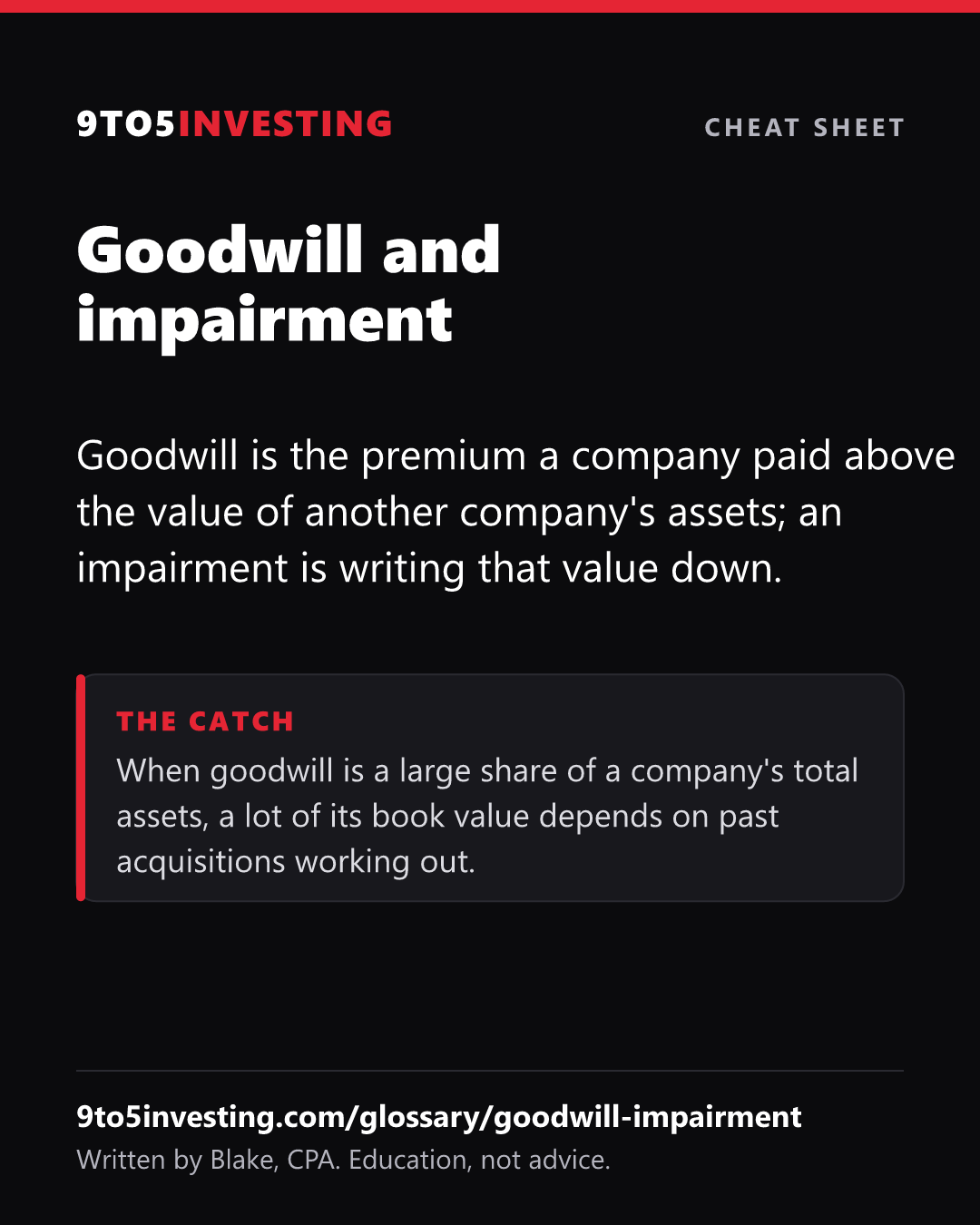
Goodwill is the premium a company paid above the value of another company's assets; an impairment is writing that value down.
Goodwill shows up when one company buys another for more than the fair value of its identifiable assets minus its liabilities. All that I mean is it's the extra amount paid for things like the brand, the customers and the expected synergies that don't have their own line on the balance sheet.
For US public companies, goodwill isn't expensed a little each year. Instead, it gets tested for impairment at least once a year, and if the acquired business is worth less than what's on the books, the company writes it down and takes a charge.
For you, a big impairment is basically the company admitting it overpaid for an acquisition. It's a noncash charge, so it doesn't drain the bank account that day, but the cash was already spent when the deal happened.
Example. As an example, a company pays $1 billion for a business whose assets minus liabilities are worth $700 million. It records $1 billion minus $700 million, which is $300 million of goodwill. If a few years later it decides that business is only worth $850 million in total, it takes an impairment of $1 billion minus $850 million, which is $150 million.
The catch. When goodwill is a large share of a company's total assets, a lot of its book value depends on past acquisitions working out.
Where I talk about it
- Sandisk Stock Split: The Price-Target Trap to Avoid at 8:48
- TSLA vs SPCX: Which Stock Should You Own? at 13:49
- Stop Copying Buffett’s Stocks. Copy His Strategy. at 1:00
- Buy the Dip vs Dollar Cost Averaging: A 20-Year Test at 6:42
Cheat sheet
Free to save and share. Tap the image to open it full size.
Related terms
This is education, not tax or investment advice. I'm a CPA, but I'm not your CPA. Full disclaimer.